Visual explainer
Transfer Learning
Freeze a pretrained body and train a small head first, then thaw the top gently. Reuse wins tiny data and fails across far domains.
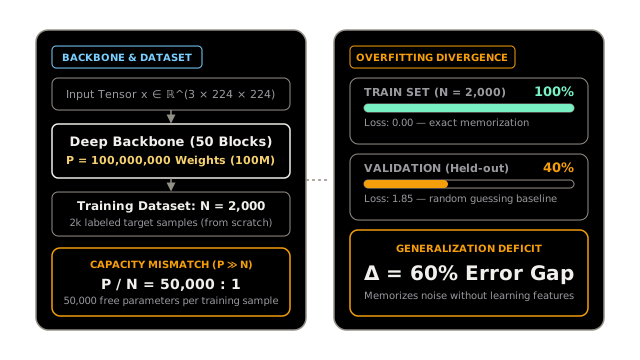
Training a massive deep neural network from scratch requires an enormous volume of labeled data to constrain millions of free parameters. When an overparametrized model is tasked with learning from a tiny custom dataset, optimization encounters the capacity collapse dilemma:
- The capacity mismatch: A deep backbone with free weights across 50 residual blocks trained against only labeled training examples yields an extreme parameter-to-sample ratio:
- Memorization vs generalization: With 50,000 unconstrained degrees of freedom per row, gradient descent easily drives training loss to ( accuracy) by carving isolated decision boundaries around individual noise artifacts.
- The generalization void: On held-out validation data, the model collapses to chance accuracy (, ), revealing a catastrophic generalization gap. The model memorized lookup keys rather than extracting semantic concepts.
General Below, Task Above
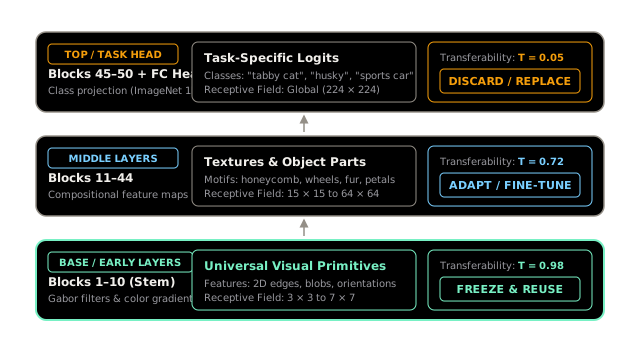
Deep representations naturally organize into an empirical feature hierarchy (Yosinski et al., 2014) as spatial information flows upward through network layers:
- Base / Early layers (Blocks 1–10): With small local receptive fields ( to ), early convolutional kernels and patch embeddings converge to Gabor-like directional edge filters, orthogonal color gradients, and line terminations. These low-level primitives carry a transferability index of —they are universal across all visual domains and should always be frozen and reused.
- Middle layers (Blocks 11–44): Expanding receptive fields ( to ) compose edges into textural motifs, repeating patterns, and object components (wheels, fur, petals). With , these features are moderately general and can adapt to new domain geometries.
- Top / Task head (Blocks 45–50 + Logits): With global receptive fields, late layers assemble parts into domain-specific categories (e.g., 1,000 ImageNet classes). Their transferability drops to . They are completely specific to the source task and must be stripped and replaced.
Lock Body, Teach Head
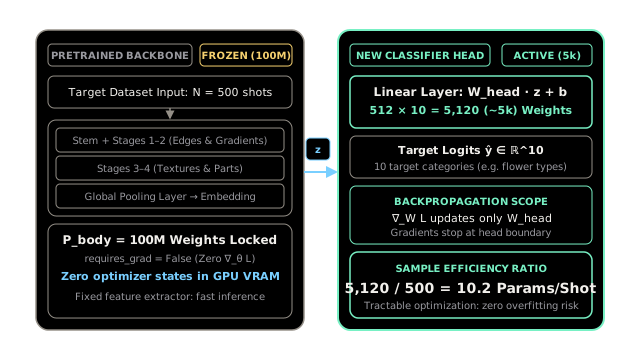
The linear probe strategy (feature extraction) reuses universal visual representations without risking overparameterization:
- Freezing the backbone: Setting
requires_grad = Falseacross all 100M body weights completely halts gradient calculation for the feature extractor. Backpropagation stops at the final layer boundary, dropping optimizer state memory in GPU VRAM to zero for the backbone. - Linear classification head: The source classification layer is replaced with a single linear projection matrix: For feature dimension and target classes, the head contains only trainable parameters.
- Taming the ratio: Evaluated on a tiny budget of shots ( images per class), the parameter ratio flips from down to: Because 10 parameters per sample cannot overfit, the model trains in minutes while preserving rich geometric priors.
Thaw the Top
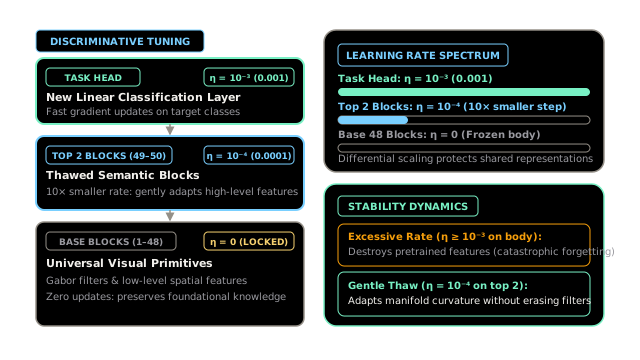
When target datasets grow to thousands of samples, keeping the entire body locked leaves performance on the table. However, updating all layers with a standard learning rate induces catastrophic forgetting, where large initial error gradients overwrite pre-trained weights. Discriminative fine-tuning and gradual unfreezing (Howard & Ruder, 2018) solve this:
- Differential learning rate spectrum:
- Base 48 blocks: (locked, preserving universal Gabor and edge filters).
- Top 2 blocks (Blocks 49–50): (, a reduced rate).
- Classification head: (, standard convergence rate).
- Smooth adaptation: Small learning rates on high-level feature blocks gently deform semantic cluster manifolds to separate target categories without disrupting the underlying coordinate system.
Reuse Wins Tiny Data
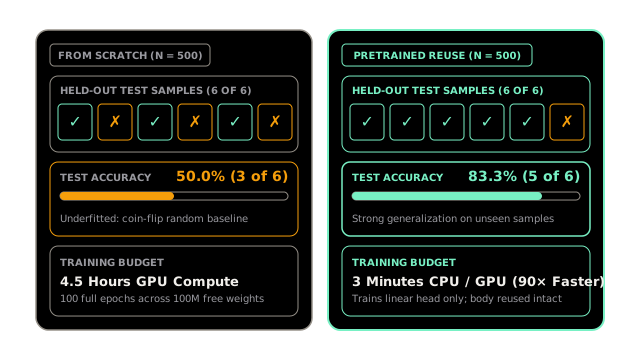
Controlled benchmarks on identical small sample sizes reveal the sample efficiency dividend of pre-trained feature reuse:
- Training from scratch (random initialization): With weights initialized from random Gaussian distributions , backpropagation must simultaneously discover low-level edge filters and high-level boundaries from only 500 examples. After 4.5 hours of GPU compute across 100 epochs, optimization stalls at test accuracy ( of test samples correct), effectively guessing between classes.
- Pretrained feature reuse: The linear probe reuses millions of hours of pre-computed feature representations. Reaching convergence in just 3 minutes ( faster), test accuracy surges to ( of test samples correct). Pre-training provides an inductive bias that turns sample starvation into production-ready accuracy.
Count Labels First
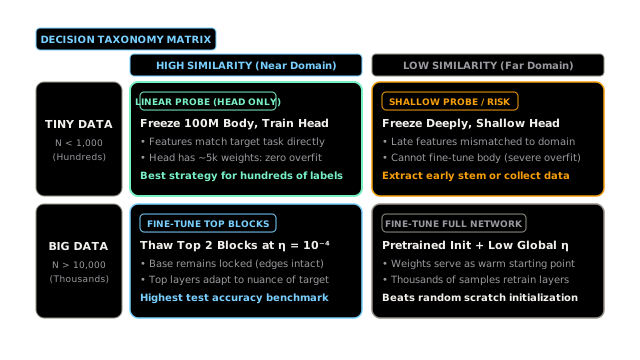
Choosing whether to freeze, partially thaw, or fully fine-tune depends on a two-dimensional decision matrix balancing sample size against domain similarity:
- Small dataset () + High similarity: Linear probe. Freeze the entire backbone and train only the linear output head. The pre-trained features match the target domain, and freezing prevents catastrophic overfitting.
- Small dataset () + Low similarity: High risk / shallow probe. Pre-trained high-level features fail to align, but fine-tuning will overfit. The optimal strategy is training a simple linear probe on early/mid layers while prioritizing target data collection.
- Large dataset () + High similarity: Fine-tune top blocks. With thousands of labeled examples, unfreeze the top layers at while training the head at for state-of-the-art accuracy.
- Large dataset () + Low similarity: Full fine-tune. Initialize the entire network with pre-trained weights to accelerate convergence, then train all layers with a decayed learning rate schedule.
Where It Breaks
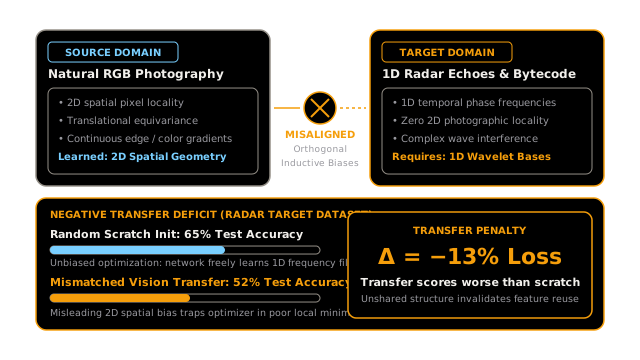
Transfer learning is not magic: it succeeds only when the source and target domains share underlying statistical invariants. When domains are fundamentally divergent, inductive bias causes negative transfer:
- Inductive misalignment: Pre-training on natural RGB photography (ImageNet) optimizes for 2D spatial pixel correlations, color balance, and translational equivariance. When transferred to synthetic aperture radar (SAR) phase spectrograms, audio waveforms, or symbolic bytecode, these spatial priors actively mislead optimization.
- The negative transfer penalty: The model attempts to force non-spatial frequency echoes through 2D photographic edge filters. In comparative testing, training a compact architecture from scratch achieves accuracy, while the mismatched transfer model achieves only —a severe performance degradation. When domains lack shared invariants, pre-training acts as an anchor rather than an engine.
The Quick Version
- Overparameterization causes a weight-to-sample mismatch, memorizing tiny training sets () while failing validation ().
- Early layers extract universal Gabor edges (), middle layers compose textures (), and top layers specialize to source logits ().
- Freezing 100M body weights and training a 5k linear head cuts trainable weights to per shot, stopping overfitting.
- Thawing the top two blocks at alongside a head adapts high-level features without catastrophic forgetting.
- On identical 500-shot datasets, feature reuse achieves accuracy in 3 minutes versus after 4.5 hours from scratch.
- Follow the rule: freeze the body for small similar data, tune the top for large datasets, and beware far-domain shifts.
- Negative transfer occurs when source and target share no invariants; photographic spatial priors degrade radar accuracy by .