Visual explainer
What Is Machine Learning?
Machine learning fits patterns from data. Follow a toy classifier from labelled examples to a held-out test and see why memorization fails.
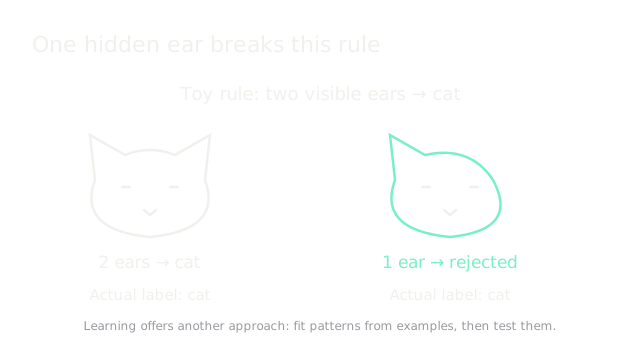
Machine learning fits patterns from data to perform a task. In supervised learning, examples pair inputs with answers. The ear-count sketch shows why a hand-written visual rule can be brittle; learning still needs suitable data and evaluation, and does not automatically outperform rules.
Three Learning Signals
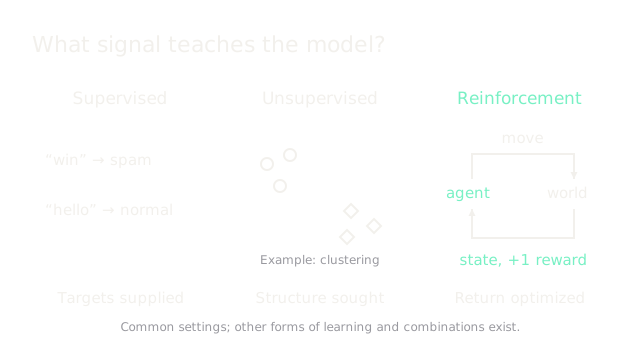
Supervised learning uses supplied targets. Unsupervised learning seeks structure, with clustering as one example. Reinforcement learning learns actions from interaction to improve expected cumulative reward. These are common settings; combinations and other forms exist.
Select A Boundary
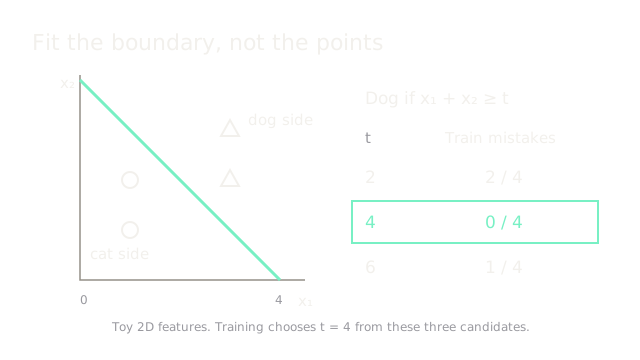
This toy has two numerical features, x₁ and x₂. Cats are (1,1) and (1,2); dogs are (3,3) and (3,2). Predict dog when their sum reaches threshold t. Candidates 2, 4, and 6 make two, zero, and one training mistakes. Training selects 4.
Hold Examples Apart
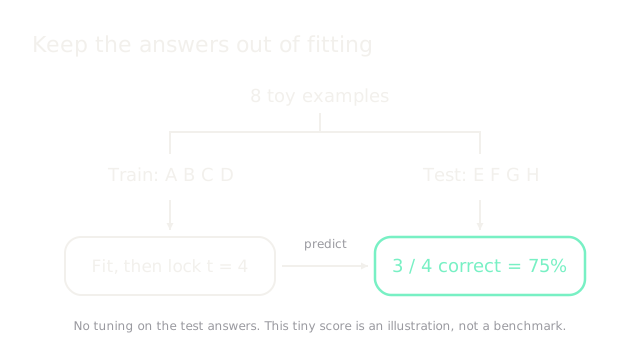
Split the eight toy examples before fitting. A–D select the threshold; E–H test the locked model. Real model selection also needs validation data or cross-validation. Keep the final test answers out of tuning, preprocessing fits, and feature selection.
Predict Unseen Inputs
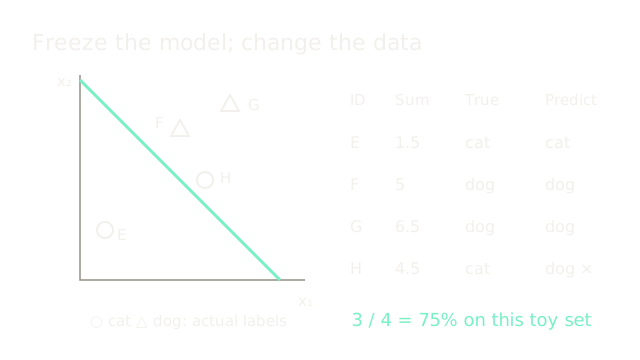
Fresh examples E (.5,1), F (2,3), G (3,3.5), and H (2.5,2) have labels cat, dog, dog, cat. Their sums produce predictions cat, dog, dog, dog. Accuracy is 3/4 = 75%. This tiny illustration proves no population-level performance guarantee.
Match Task And Feedback
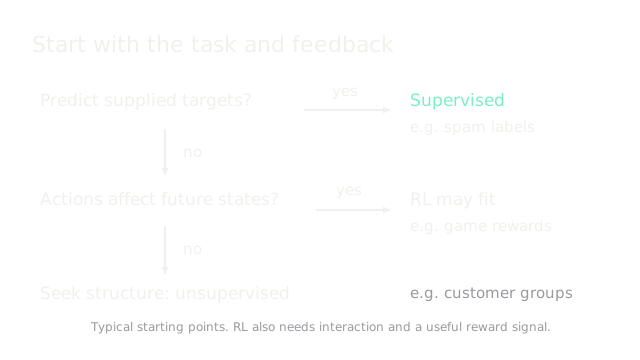
Start from the output you need and the feedback you can obtain. Labels support prediction; interaction and rewards can support sequential decisions. Unlabelled structure may support exploration. Rewards aren't a cheap substitute for labels, and clustering doesn't supply the class meanings for free.
Where It Breaks
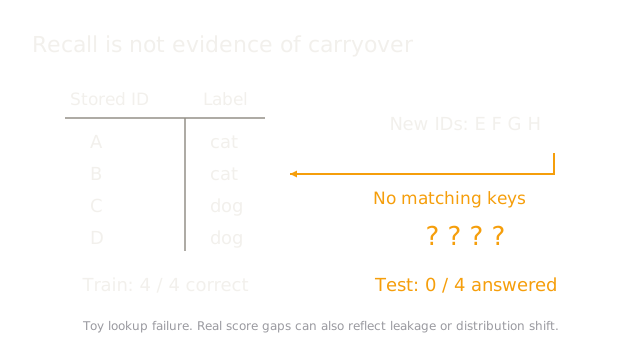
An ID-only table recalls all four stored labels, yet answers none of the four new IDs. That's coverage failure, not a measured chance accuracy. Perfect training recall doesn't establish generalization; real train/test gaps can also come from leakage, noise, or distribution shift.
The Quick Version
- Machine learning fits patterns from data for a task.
- Targets, structure, and rewards provide different learning signals.
- Training selects parameters using an objective.
- Split before fitting; reserve test data for final evaluation.
- The toy classifier scores 3/4 on held-out examples.
- Choose feedback to match the task and available data.
- Perfect training recall does not prove generalization.