Comparison
AI vs Machine Learning vs Deep Learning vs Gen AI
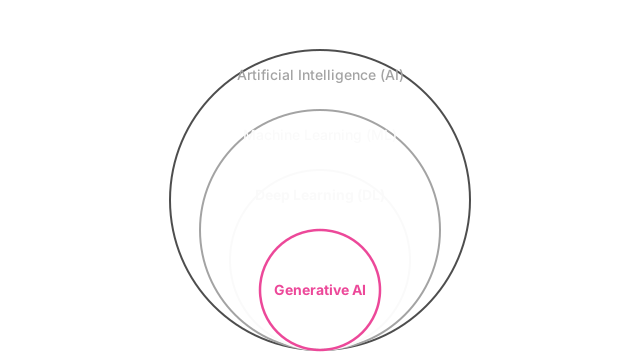
Understanding the nested relationship from general artificial intelligence down to modern generative models.
Verdict: They aren't competing alternatives; they are concentric layers of specialization.
Quick Version (TL;DR)
Understanding the nested relationship from general artificial intelligence down to modern generative models.
The Short Answer
The terms are often used interchangeably, but they actually form a nested hierarchy of specialisation. Artificial Intelligence (AI) is the broadest concept—any technique that enables computers to mimic human intelligence. Machine Learning (ML) is a subset of AI where machines learn patterns from data instead of being explicitly programmed. Deep Learning (DL) is a subset of ML using multi-layered artificial neural networks. Finally, Generative AI (Gen AI) is a specialised subset of deep learning focused on creating new content (text, images, audio) rather than just classifying or predicting existing data.
Where They Differ
| Feature | Artificial Intelligence (AI) | Machine Learning (ML) | Deep Learning (DL) | Generative AI (Gen AI) |
|---|---|---|---|---|
| The Core Idea | Mimicking human behaviour and decision-making. | Learning from data without explicit programming. | Learning complex representations via neural networks. | Creating net-new artifacts from learned distributions. |
| Typical Architecture | Rules, logic trees, or statistical models. | Random Forests, SVMs, Linear Regression. | Multi-layer Perceptrons, CNNs, RNNs. | Transformers, Diffusion Models, GANs, VAEs. |
| Data Requirements | Can be rule-based (zero data). | Needs structured tabular data. | Requires massive amounts of unstructured data. | Requires internet-scale datasets to pre-train. |
| Hardware | Can run on standard CPUs. | Typically runs on CPUs or small GPUs. | Requires dedicated GPUs for training. | Requires massive GPU clusters (H100s/A100s). |
| Primary Output | Decisions, logical deductions, or actions. | Predictions, classifications, or cluster assignments. | Complex classifications (e.g., computer vision). | Original text, images, code, or audio. |
Choose A When
(When to use Traditional AI & ML)
- You have structured data: Your data lives in a SQL database, Excel file, or neat CSV (e.g., predicting customer churn based on purchase history).
- Interpretability is critical: You need to explain exactly why a decision was made (e.g., credit scoring, medical diagnosis). A Random Forest or Linear Regression model provides feature importance.
- Compute budget is limited: You need a model that trains in minutes on a laptop and costs pennies to run in production.
- The task is deterministic: You are building an expert system or a rule-based game AI where specific inputs must always yield the exact same outputs.
Choose B When
(When to use Deep Learning & Gen AI)
- You have unstructured data: You are working with raw text, images, video, or audio that traditional algorithms cannot easily parse.
- You need to generate content: You want to write essays, generate marketing copy, synthesize voice, or create original images.
- The patterns are highly complex: You are tackling natural language translation, speech recognition, or autonomous driving where manual feature extraction is impossible.
- You have abundant compute: You have the infrastructure and budget to support large-scale GPU processing, either training from scratch or fine-tuning existing foundation models.
What People Get Wrong
Assuming Gen AI is the only kind of AI that matters
Because Large Language Models (LLMs) dominate the news, many teams try to force Gen AI into problems where a simple XGBoost model would be faster, cheaper, and more accurate. Use a generative model to write a poem; use traditional ML to predict a stock price.
Treating them as competitors
AI, ML, DL, and Gen AI are not competing technologies you have to choose between. They are nested Russian dolls. If you are using Generative AI, you are by definition using Deep Learning, Machine Learning, and Artificial Intelligence all at once.