Comparison
Batch Norm vs Layer Norm vs RMSNorm
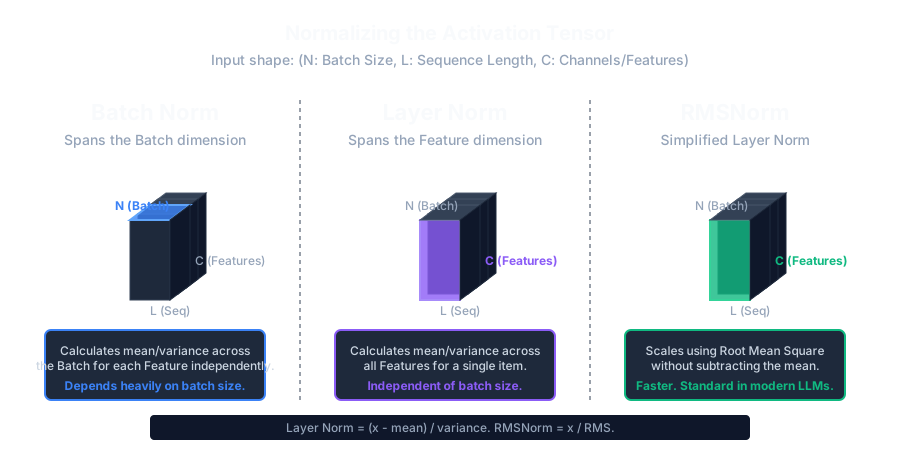
How modern neural networks stabilize their internal activations during training by standardizing the math.
Verdict: Batch Norm is for Vision (CNNs) where large batch sizes are possible. Layer Norm and RMSNorm are for Language (Transformers) where sequences are long and batch sizes are small.
Quick Version (TL;DR)
How modern neural networks stabilize their internal activations during training by standardizing the math.
The Short Answer
Deep neural networks suffer from "internal covariate shift"—as the network trains, the distribution of numbers flowing through the hidden layers goes wild, making training unstable. Normalization fixes this by forcing the activations to have a mean of 0 and a variance of 1. The difference lies in which numbers you average together.
- Batch Normalization (BatchNorm): Averages the values of a single feature across the entire batch of data.
- Layer Normalization (LayerNorm): Averages the values of all features for a single item in the batch.
- RMSNorm (Root Mean Square Normalization): A faster, modern variant of LayerNorm that skips the mean-centering step and only scales the variance.
Where They Differ
| Feature | Batch Norm | Layer Norm | RMSNorm |
|---|---|---|---|
| Dimension Spanned | The Batch () | The Features/Channels () | The Features/Channels () |
| Depends on Batch Size? | Yes. Fails if batch size is too small. | No. Works perfectly with batch size 1. | No. Works perfectly with batch size 1. |
| Primary Use Case | Computer Vision (CNNs like ResNet). | Sequence Models (RNNs, original Transformers). | Modern LLMs (Llama, Gemma). |
| Math Complexity | (x - mean) / variance | (x - mean) / variance | x / RMS |
| Speed | Fast | Fast | Fastest |
The Problem with Batch Norm in Language
Batch Norm revolutionized Computer Vision. In a CNN classifying images, you can easily load a batch of 256 images. Calculating the average brightness of the top-left pixel across all 256 images gives a very stable, reliable statistic.
However, Batch Norm falls apart in Natural Language Processing (NLP) for two reasons:
- Dynamic Sequence Lengths: Sentences have different lengths. If you try to calculate an average across the batch for "Word 50," but half the sentences in your batch only have 20 words, the math breaks down.
- Tiny Batch Sizes: Transformers are memory hogs. You might only be able to fit a batch size of 2 or 4 into GPU memory. Calculating a statistical average over just 2 items yields wildly inaccurate, noisy numbers that destabilize training.
The Layer Norm Solution
Layer Norm solves this by ignoring the batch dimension entirely. It looks at a single token (e.g., the word "Apple") and calculates the mean and variance across the model's internal feature dimension (e.g., all 4,096 embedding values for that specific word).
Because it normalizes within the single token itself, it doesn't care if the batch size is 2 or 2,000, and it doesn't care how long the sequence is. This made it the default choice for the original Transformer (and BERT/GPT).
The RMSNorm Upgrade
Years after LayerNorm became the standard, researchers realized that the "centering" part of the normalization (subtracting the mean) was computationally expensive and didn't actually help the model learn better.
RMSNorm throws away the mean centering. It just divides the activations by their Root Mean Square (a measure of magnitude). This saves a significant amount of computation time.
Choose A When
(When to use Batch Norm)
- You are building Computer Vision models: CNNs (like ResNets or EfficientNets) still rely heavily on Batch Norm.
- Your batch size is consistently large: (e.g., > 32).
Choose B When
(When to use Layer Norm or RMSNorm)
- You are building Transformers or Sequence models: Text, audio, or time-series data.
- You are training massive LLMs: Use RMSNorm. It is the industry standard for state-of-the-art models like Llama 3, Mistral, and Gemma because the 10-20% speedup in normalization overhead saves millions of dollars in GPU compute.
- Your batch size is tiny: If you are forced to train with a batch size of 1 or 2 due to memory limits, Batch Norm will fail.