Naive vs Modular vs Agentic RAG
Comparing architectures for Retrieval-Augmented Generation.
Verdict: Start with Modular RAG (adding a reranker) for the best ROI; graduate to Agentic RAG only when the user's queries are too complex for a single database search.
The Short Answer
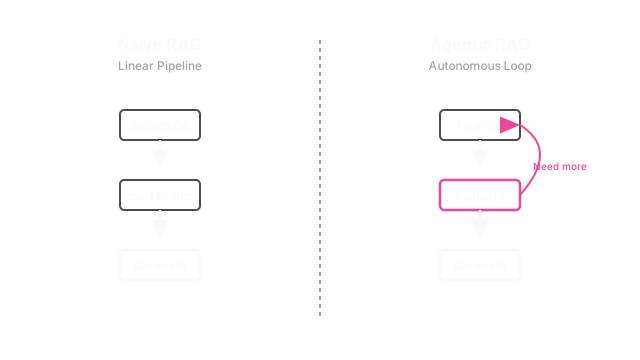
Naive RAG takes the user's prompt, searches a vector database, pastes the top 5 results into the prompt, and generates an answer. It fails completely if the question is complex. Modular RAG adds specific routing, query expansion, and reranking to clean up the retrieval pipeline. Agentic RAG turns the LLM into an autonomous agent that can decide when to search, evaluate if the results are good enough, and search again if needed before answering.
Where They Differ
| Feature | Naive RAG | Modular RAG | Agentic RAG |
|---|---|---|---|
| Pipeline Flow | Linear (Search Generate) | Linear with enhancements | Loops (Search Evaluate Repeat) |
| Latency | Very Low | Low | High (Takes seconds or minutes) |
| Cost | 1 LLM call | 1 LLM call + Reranker | Multiple LLM calls |
| Handles Complex Queries | Poorly | Decently | Excellently |
Choose Naive or Modular RAG When
- You are building an internal knowledge base search: If the user is just asking "How do I setup my VPN?", a fast semantic search followed by a generation step is perfectly sufficient. Adding a Cross-Encoder reranker (Modular RAG) immediately boosts accuracy for almost zero engineering effort.
- Latency is critical: RAG must often happen in hundreds of milliseconds. A linear pipeline guarantees a fast response.
Choose Agentic RAG When
- Queries require aggregation or synthesis: If a user asks "How did our Q3 revenue compare to Q2, and what did our main competitor report?", Naive RAG will fail. Agentic RAG allows the LLM to write a SQL query for Q3, evaluate the result, write another for Q2, do a web search for the competitor, and then synthesize the answer.
- The search space is heavily fragmented: When answers live across Notion, Jira, Slack, and PostgreSQL, you need an Agent to decide which tools to call and in what order.
What People Get Wrong
People rush to build Agentic RAG pipelines using frameworks like LangChain or AutoGen because it sounds advanced, only to discover it takes 30 seconds to answer a simple question and costs 5x as much in API fees. The vast majority of business problems can be solved by an extremely well-tuned Modular RAG pipeline (Query Expansion + Hybrid Search + Reranking) without giving the LLM autonomous control over the loop.