RNN vs LSTM vs Transformer
Comparing sequential token processing with parallel global attention mechanisms.
Verdict: Transformers are the default for sequence modeling due to their parallelization and long-context capabilities; use RNNs/LSTMs only on strictly constrained hardware or extremely long streams where constant-memory inference is required.
The Short Answer
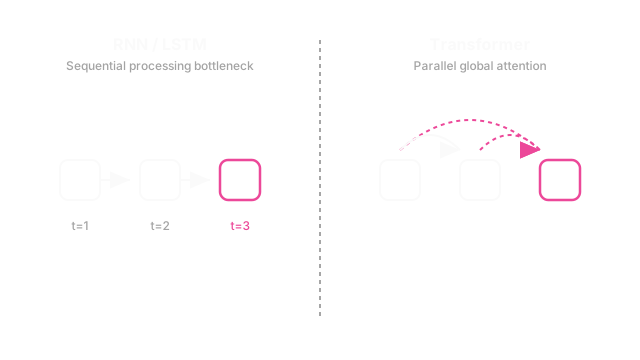
RNNs and LSTMs read sequences one token at a time, bottlenecking training and losing information over long contexts. Transformers read the entire sequence in parallel using self-attention, allowing them to train vastly faster on modern GPUs and directly connect distant tokens.
Where They Differ
| Feature | RNN / LSTM | Transformer |
|---|---|---|
| Processing Style | Sequential (must wait for step to compute step ) | Parallel (computes all steps simultaneously during training) |
| Dependency Path | path length between token and token | path length (any token attends directly to any other) |
| Memory at Inference | (fixed-size hidden state) | (must store the KV cache for all past tokens) |
| Long-Range Context | Poor (RNNs suffer vanishing gradients; LSTMs delay it but eventually forget) | Excellent (limited only by the size of the attention window) |
Choose A When
- You are constrained by inference memory: LSTMs maintain a fixed-size state regardless of how many tokens they process. This makes them ideal for endless streams (like sensor data) where a Transformer's KV cache would inevitably run out of memory.
- You are modeling strict state machines: If the problem relies heavily on knowing the exact sequential order without skipping, recurrent architectures can sometimes capture stateful dynamics more naturally.
Choose B When
- You need to train on a lot of data: The sequential bottleneck of RNNs means they cannot fully utilize modern GPUs during training. Transformers were designed specifically to be parallelizable.
- You need long-range recall: In translation or code generation, the model must perfectly recall a word from thousands of tokens ago. Transformers retrieve this in steps; LSTMs degrade geometrically.
What People Get Wrong
People assume that because Transformers process data in parallel, they have solved the sequence problem forever. In reality, Transformers struggle with the compute cost of self-attention at inference time for very long contexts, leading to the resurgence of modern RNN-like State Space Models (e.g., Mamba) that attempt to combine parallel training with constant-time inference.