Confounding & Colliders
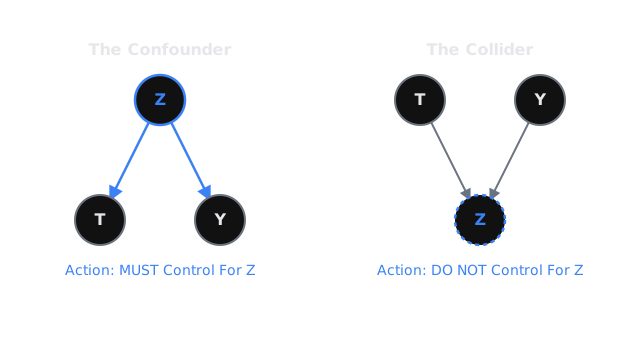
Controlling for a confounder removes bias. Controlling for a collider creates bias. The hardest part of causal inference is knowing which one you are looking at.
Why Does This Exist?
When building machine learning models, the standard instinct is to feed the algorithm every available feature. More data is better, right?
In purely predictive ML, yes. But in causal inference, adding a variable to your model can actively destroy your ability to estimate a true effect. The theory of causal graphs identifies exactly which variables you must include (confounders) and which variables you must actively exclude (colliders) to get the right answer. Understanding these two opposing structures is the difference between extracting truth and manufacturing a lie out of perfectly good data.
Think of It Like This
Confounding (The Fork)
Imagine measuring the relationship between carrying a lighter and getting lung cancer.
Think of It Like This
Carrying a lighter doesn't cause lung cancer. But they are highly correlated. Why? Because smoking causes people to carry lighters, and smoking causes lung cancer. Smoking is the confounder. If you don't control for smoking, you will conclude lighters are deadly.
Colliders (The Trap)
Imagine investigating the relationship between being attractive and being a talented actor.
Think of It Like This
In the general population, beauty and acting talent are completely uncorrelated. But if you only look at famous Hollywood celebrities, you might notice that the most attractive ones are terrible actors, and the brilliant actors are average-looking. Why? Because to become famous (the collider), you must be either very attractive or very talented. By restricting your data only to famous people (conditioning on the collider), you artificially created a negative correlation where none exists in reality.
How It Actually Works
These phenomena emerge from three fundamental causal structures involving a Treatment (), an Outcome (), and a third variable ().
1. The Confounder (Fork)
Structure:
A confounder causes both the treatment and the outcome. Because and share a common cause, they will move together, creating a spurious correlation.
- Path status: Open by default. Information flows freely from up to and down to .
- Action: You must control for (e.g., add it as a feature in a regression). Controlling for blocks the spurious path, isolating the direct causal effect . Failure to control for a confounder leads to Omitted Variable Bias.
2. The Mediator (Chain)
Structure:
A mediator is the mechanism through which the treatment affects the outcome.
- Path status: Open by default. This is an actual causal path!
- Action: You must not control for if you want the total effect of on . If you control for the mediator, you block the very effect you are trying to measure.
3. The Collider (Inverted Fork)
Structure:
A collider is a variable that is caused by both the treatment and the outcome (or by unobserved factors related to them).
- Path status: Blocked by default. Because the two arrows collide at , no spurious correlation flows between and .
- Action: You must not control for . Bizarrely, if you condition on a collider, you unblock the path and create a spurious correlation where none existed before. This is called Collider Bias (or Berkson's Paradox / Selection Bias).
Code
Let's simulate Collider Bias. We will generate a population where Talent and Beauty are completely independent. Then we will condition on a collider (Fame) and watch a spurious correlation appear.
import numpy as npimport statsmodels.api as smimport matplotlib.pyplot as plt
np.random.seed(42)N = 10000
# Talent and Beauty are completely independent, standard normal distributionstalent = np.random.normal(0, 1, N)beauty = np.random.normal(0, 1, N)
# True causal relationship: Talent -> Y? No. Beauty -> Y? No.# The true correlation is EXACTLY 0.print(f"True Correlation (Population): {np.corrcoef(talent, beauty)[0, 1]:.3f}")# -> ~ 0.000
# Now, let's create a Collider: Fame.# You become famous if your combined Talent and Beauty crosses a threshold.fame_score = talent + beautyfamous = fame_score > 1.5
# Let's run a regression ONLY on the famous people (Conditioning on the collider)talent_famous = talent[famous]beauty_famous = beauty[famous]
# In this sub-population, what is the correlation?print(f"Collider Correlation (Famous only): {np.corrcoef(talent_famous, beauty_famous)[0, 1]:.3f}")# -> ~ -0.450 (A massive negative correlation!)
# If we run a linear regression on the filtered data:X = sm.add_constant(talent_famous)model = sm.OLS(beauty_famous, X).fit()print(f"Regression Coefficient: {model.params[1]:.3f}")# -> -0.45. The model confidently says talent makes you less beautiful!Watch Out For
Selection Bias is just Collider Bias.
If your dataset is collected through an opt-in process, survey response, or survival, you are implicitly conditioning on "Presence in the Dataset". If both the treatment and outcome influence whether a row makes it into your dataset, you have conditioned on a collider and ruined your estimates before even training a model.
Over-controlling in ML models.
Random Forests and Gradient Boosting models automatically condition on every feature you give them. If you blindly feed a tree model a dataset containing colliders or mediators, it will use them to minimize predictive loss, irrevocably destroying any causal interpretation of the feature importances.
The Quick Version
- A Confounder causes both your features and your target. You must control for it to see the truth.
- A Mediator sits on the causal path between your features and your target. Do not control for it.
- A Collider is caused by both your features and your target. If you control for it (or filter your dataset based on it), you actively create fake correlations.
- Never throw "all available features" into a model if you intend to use the output to make interventions.