Differential Privacy
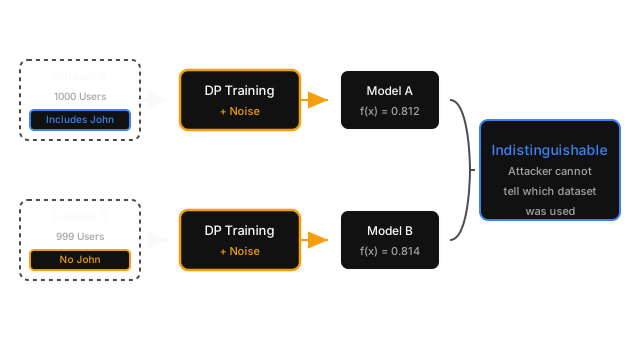
Differential privacy adds a calculated amount of mathematical noise during training, guaranteeing that a model's outputs will look essentially identical whether any specific individual's data was included in the training set or not.
Why Does This Exist?
When organizations train machine learning models on sensitive data (like medical histories or financial transactions), they face a major threat from privacy attacks like Membership Inference and Model Inversion.
Traditional privacy methods—like Redacting PII or stripping names from a dataset—are no longer enough. If an attacker knows your zip code, your age, and the exact dates you visited a hospital, they can often re-identify you even without your name.
Differential Privacy (DP) is not a specific algorithm; it is a strict mathematical definition of privacy. A system is differentially private if an observer looking at the model's outputs cannot tell whether a specific individual's data was included in the training set. It provides a mathematical guarantee that participating in a dataset will not compromise your privacy.
Think of It Like This
A survey on illegal behavior
Imagine a sociologist wants to know what percentage of students cheat on exams. If they just ask, students will lie out of fear of getting caught.
Instead, the sociologist uses a technique called Randomized Response:
- The student flips a coin in secret.
- If it's Heads, they must answer truthfully.
- If it's Tails, they flip the coin again. If the second flip is Heads, they say "Yes" (even if they didn't cheat). If it's Tails, they say "No".
Because of the noise added by the coins, if a student answers "Yes", the administration cannot punish them—they might have just flipped Tails then Heads. The individual's privacy is mathematically guaranteed.
However, because the sociologist knows the statistical probability of the coin flips, they can easily subtract the expected "noise" from the total survey results to find the true percentage of cheaters across the whole school. Differential Privacy does exactly this, but for gradients instead of survey answers.
How It Actually Works
DP-SGD (Differentially Private Stochastic Gradient Descent)
In machine learning, Differential Privacy is usually implemented by modifying the training algorithm itself, most commonly through DP-SGD.
Normally, during gradient descent, the model calculates how much to adjust its weights based on the loss of a batch of data. In DP-SGD, two crucial steps are added:
-
Gradient Clipping (Bounding the impact): If one specific patient's data is highly unusual, it will generate a massive gradient, pulling the model's weights heavily in one direction (memorization). DP-SGD clips the gradient of every individual data point to a maximum threshold. This ensures no single person can have too much influence on the model.
-
Noise Addition (Hiding the individual): After clipping the gradients, DP-SGD adds random Gaussian noise to the sum of the gradients before updating the weights. This noise acts like the coin flip in the survey analogy. It obscures the exact contribution of any single person, while still allowing the general statistical trend of the batch to push the model in the right direction.
The Privacy Budget (Epsilon - ε)
Differential privacy is quantified by a parameter called Epsilon (ε), known as the privacy budget.
- A low ε (e.g., 0.1) means lots of noise is added. Privacy is extremely high, but model accuracy will suffer.
- A high ε (e.g., 10.0) means very little noise is added. The model will be highly accurate, but the privacy guarantee is weak.
Every time you query the data or train for another epoch, you "spend" some of this privacy budget.
Code
# A conceptual look at DP-SGD vs standard SGDdef dp_sgd_step(model, batch_data, batch_labels, learning_rate, clip_value, noise_multiplier): # 1. Compute gradients PER EXAMPLE (not aggregated over the batch yet) per_example_gradients = compute_per_example_gradients(model, batch_data, batch_labels) total_gradient = 0 for grad in per_example_gradients: # 2. Gradient Clipping: Bound the influence of each individual grad_norm = compute_norm(grad) clipped_grad = grad * min(1.0, clip_value / grad_norm) total_gradient += clipped_grad # 3. Add Gaussian Noise to obscure individual contributions # Noise scale is proportional to the clip_value noise = generate_gaussian_noise(scale=noise_multiplier * clip_value) total_gradient += noise # 4. Update model weights average_gradient = total_gradient / len(batch_data) update_model_weights(model, average_gradient, learning_rate)(Note: In practice, developers use libraries like Opacus for PyTorch or TensorFlow Privacy, which handle the complex vector math of per-example gradients and noise generation automatically.)
Watch Out For
The catastrophic accuracy trade-off
There is no free lunch in Differential Privacy. If you want a strong mathematical guarantee of privacy (a low ε), you must add a lot of noise. Adding a lot of noise destroys the model's ability to learn fine-grained details, leading to massive drops in accuracy. DP models routinely perform 5% to 20% worse than non-DP models on the same data.
It does not protect against population-level insights
Differential Privacy guarantees that you cannot learn anything about an individual. It does NOT prevent you from learning about a group. If the model learns that "smoking causes lung cancer," that is a population-level insight. If you are a smoker, your risk is exposed by the model, but not because your specific data was leaked; it was exposed because the general trend is true for the population.
The Quick Version
- Differential Privacy (DP) is a strict mathematical framework that guarantees a model's output doesn't reveal whether any specific individual was in the training data.
- It is the ultimate defense against Membership Inference and Model Inversion attacks.
- It is typically implemented using DP-SGD, which involves clipping per-example gradients and adding Gaussian noise during training.
- The privacy parameter Epsilon (ε) controls the trade-off: higher privacy means lower accuracy.
- DP protects individuals, but still allows the model to learn general statistical truths about the population.