Model Inversion
Model inversion is a reverse-engineering attack where an adversary reconstructs the actual raw training data (like faces or text) by analyzing how the model behaves.
Why Does This Exist?
When developers train a facial recognition system, they input thousands of photos of faces and the model outputs a mathematical map of those faces in its weights. The standard belief was that this process is a one-way street: you can turn a face into numbers, but you can't turn the numbers back into a face.
Model Inversion proves this belief wrong. It is a class of privacy attacks where an adversary takes a fully trained model and extracts the original training data out of it. While Membership Inference only tells the attacker if someone was in the dataset, Model Inversion actually reconstructs what that person looks like, creating a massive privacy breach for biometric and medical models.
Think of It Like This
Drawing a suspect with a police sketch artist
Imagine a police sketch artist who has seen a suspect, but refuses to just show you the photo.
You decide to trick the artist. You draw a random squiggle on a piece of paper and ask, "Is this the suspect?" The artist says, "No, the eyes are completely wrong." You erase it, draw better eyes, and ask again. The artist says, "Better, but the nose is too small."
You repeat this process thousands of times. Even though the artist never showed you the original photo, by giving you constant feedback on how close you are getting, you eventually draw a perfect sketch of the suspect.
Model inversion is the mathematical equivalent of this process, using the model's confidence scores as the "feedback."
How It Actually Works
The Optimization Process (White-Box)
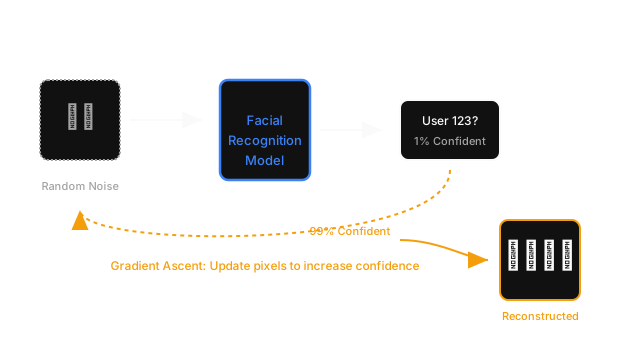
In a white-box scenario (where the attacker has access to the model's weights), the attacker uses the same math used to train the model, but in reverse.
- Start with noise: The attacker creates an image consisting entirely of random static.
- Target a class: The attacker decides they want to reconstruct the face of "Class 5" (e.g., John Doe).
- Forward Pass: They feed the static image into the model. The model predicts it is Class 5 with 0.0001% confidence.
- Gradient Ascent: They calculate the gradient of the loss with respect to the input pixels (just like in an Adversarial Example). But instead of making the model wrong, they update the pixels to make the model more confident that it is Class 5.
- Iterate: After thousands of updates, the static morphs into a blurry, ghostly image of John Doe's actual face.
Generative Priors
Early model inversion attacks produced very noisy, unnatural images. Modern attacks use a Generative Adversarial Network (GAN) as a "prior." Instead of optimizing raw pixels (which can result in weird colors and shapes), the attacker optimizes the latent space of a GAN trained on human faces. This forces the optimization process to only generate realistic-looking faces, dramatically improving the quality of the reconstructed image.
Code
import torch
def model_inversion_attack(target_model, target_class, num_steps=1000, lr=0.1): # 1. Start with a random noise image. Requires gradients! reconstructed_image = torch.randn(1, 3, 64, 64, requires_grad=True) optimizer = torch.optim.Adam([reconstructed_image], lr=lr) for step in range(num_steps): optimizer.zero_grad() # 2. Forward pass through the target model output = target_model(reconstructed_image) # 3. We want to MAXIMIZE the probability of the target class # PyTorch minimizes loss, so we use negative log likelihood of the target class loss = -torch.nn.functional.log_softmax(output, dim=1)[0, target_class] # 4. Backpropagate to update the IMAGE, not the model weights loss.backward() optimizer.step() # 5. Clip image to valid pixel range reconstructed_image.data = torch.clamp(reconstructed_image.data, 0, 1) return reconstructed_imageWatch Out For
Federated Learning is not a silver bullet
Organizations often use Federated Learning to keep data private; instead of centralizing data, they send the model to the user's phone, train it locally, and only send the weight updates back to the server. Unfortunately, if an attacker controls the central server, they can perform model inversion on the weight updates themselves, reconstructing the user's private data before it is even aggregated.
Reconstruction vs. Hallucination
Sometimes, model inversion produces a highly confident image that doesn't look like the actual training data. It instead looks like a bizarre, mathematical caricature that simply activates all the right neurons in the target model. This is often the case with simpler models, whereas highly overfitted, complex models tend to yield true reconstructions of the original data.
The Quick Version
- Model Inversion is a privacy attack that reconstructs the original training data from a trained model.
- It works by using gradient ascent to modify an input until the model classifies it as a specific target class with extremely high confidence.
- It poses a massive threat to models trained on biometric data (faces, fingerprints) or medical records.
- Modern attacks use GANs to constrain the reconstruction process, resulting in highly realistic, terrifyingly accurate extracted faces.