Heterogeneous Treatment Effects (HTE)
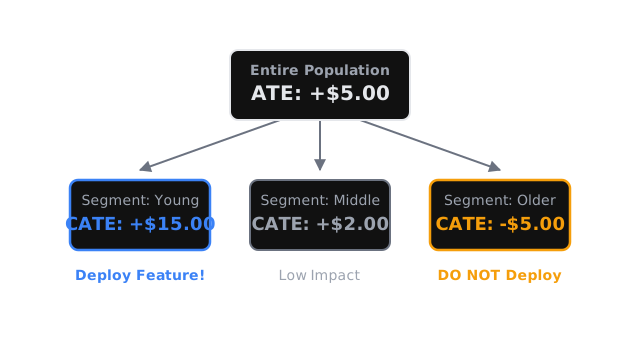
An average effect of +$5 hides the fact that the feature made +$15 for young users and lost -$5 for older users. HTE moves from asking 'Did it work on average?' to 'Who exactly did it work for?'
Why Does This Exist?
When you run an A/B test or an observational causal study, the primary output is usually the Average Treatment Effect (ATE). For example, a new ML pricing algorithm increases revenue by $2.00 per user on average. You celebrate and deploy the model to 100% of your users.
But the "Average" is often a lie. It is entirely possible that the new pricing algorithm increased revenue by $10.00 for new users, but decreased revenue by -$8.00 for loyal, long-term users. By looking only at the ATE, you missed a critical business insight.
Heterogeneous Treatment Effects (HTE) is the study of how causal effects vary across different subgroups of a population. Instead of calculating one global ATE, we calculate the Conditional Average Treatment Effect (CATE)—the treatment effect conditioned on a user's specific features.
Think of It Like This
Think of It Like This
Imagine testing a new allergy medicine. The ATE shows that, on average, symptoms improve by 10%. But when you look closer (HTE), you realize the medicine cures 100% of people with a pollen allergy, but causes severe negative side effects for people with a pet dander allergy.
If you just deployed the medicine based on the ATE, you would be hurting half your patients. CATE allows you to personalize the treatment, giving the medicine only to the people who will actually benefit from it.
How It Actually Works
Calculating CATE is difficult. In standard ML, you have ground truth labels to train on. But you can never observe a causal effect for an individual user, because you can only see one of their potential outcomes (they either got the drug or they didn't, never both).
To estimate CATE without ground truth, researchers use Meta-Learners. These are algorithms that wrap around standard ML models (like XGBoost or Random Forests) to extract personalized causal effects.
1. The S-Learner (Single)
You train a single ML model to predict the outcome , using both the user features and the Treatment as inputs. To find a user's CATE, you ask the model to predict their outcome if , then ask it again if , and subtract the two predictions.
- Pros: Simple to implement.
- Cons: Regularization might cause the ML model to completely ignore the column if the features are very strong, resulting in a CATE of 0 for everyone.
2. The T-Learner (Two)
You train two separate ML models. Model 1 is trained entirely on the Control group. Model 2 is trained entirely on the Treatment group. To find a user's CATE, you ask both models for a prediction and subtract them.
- Pros: Forces the models to acknowledge the treatment.
- Cons: If the Treatment group is very small, Model 2 will be inaccurate, causing wild errors in the CATE estimate.
3. The X-Learner
A much more advanced, multi-stage learner that solves the small-sample problems of the T-Learner by imputing the missing potential outcomes and then training two more models directly on the imputed treatment effects. It is often the best-performing meta-learner in practice.
4. Causal Forests (Double ML for CATE)
Built on the same orthogonalization math as Double Machine Learning, Causal Forests build decision trees that split users not to minimize MSE, but to maximize the difference in treatment effects between the left and right branches.
Code
Microsoft's EconML library makes estimating CATE incredibly easy using advanced meta-learners. Here is an example of an X-Learner using LightGBM.
import numpy as npimport pandas as pdfrom lightgbm import LGBMRegressor, LGBMClassifierfrom econml.metalearners import XLearner
# X: User features (Age, Income, Tenure)# T: Treatment (Received the new feature or not)# Y: Outcome (Revenue)
# 1. Initialize the X-Learner# We use LightGBM for the underlying outcome models and propensity modelsest = XLearner( models=LGBMRegressor(n_estimators=100, max_depth=3), propensity_model=LGBMClassifier(n_estimators=100, max_depth=3))
# 2. Fit the model to observational or experimental dataest.fit(Y, T, X=X)
# 3. Predict the personalized CATE for three new usersnew_users = pd.DataFrame({ 'age': [22, 45, 60], 'income': [30000, 80000, 120000], 'tenure_months': [1, 24, 120]})
cate_predictions = est.effect(new_users)
for i, cate in enumerate(cate_predictions): print(f"User {i+1} Expected Lift: ${cate:+.2f}")
# Output might show:# User 1 Expected Lift: +\$12.50 (Deploy feature!)# User 2 Expected Lift: +\$1.20 (Deploy feature!)# User 3 Expected Lift: -\$8.40 (DO NOT deploy feature to this user segment)Watch Out For
Snooping and P-Hacking.
If you run an A/B test and the overall ATE is not significant, do not slice the data into 50 different segments (by age, country, device) until you find one segment where the p-value is < 0.05. This is called p-hacking. If you look hard enough at noise, you will find a pattern. True HTE analysis requires pre-registering the segments you care about, or using rigorous ML techniques (like Causal Forests) that mathematically penalize overfitting.
The Quick Version
- Average Treatment Effect (ATE) is a blunt instrument. It obscures the fact that a treatment might help some users and hurt others.
- Heterogeneous Treatment Effects (HTE) measures how causal effects vary across a population.
- It calculates the Conditional Average Treatment Effect (CATE): the expected lift for a specific user based on their features.
- We use Meta-Learners (S-Learners, T-Learners, X-Learners) and Causal Forests to estimate these personalized effects without needing ground truth.