Responsible AI in Practice
You cannot staple ethics onto a model after it is built. Responsible AI means embedding checks for fairness, privacy, and safety into every single step of the machine learning lifecycle.
Why Does This Exist?
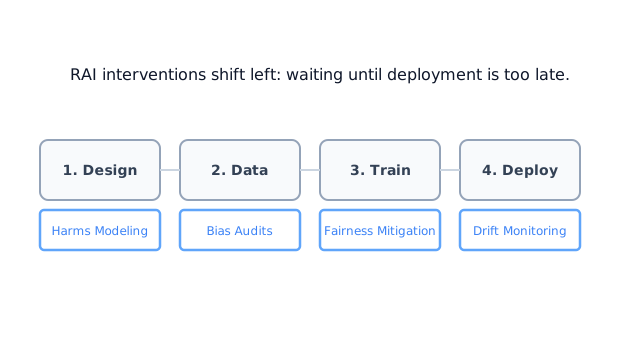
Many organizations mistakenly treat "Ethics" or "Responsible AI (RAI)" as a final checklist item right before deployment. This approach fails catastrophically. If you discover a dataset is fundamentally biased during the final pre-launch audit, you have wasted months of engineering time, because you cannot fix toxic training data at the deployment stage.
Responsible AI in Practice exists to shift these interventions left. It is the operational discipline of embedding specific ethical and safety checks into the day-to-day workflows of data engineers, ML researchers, and MLOps teams. It turns abstract principles into concrete engineering tasks across the entire lifecycle.
Think of It Like This
Think of Responsible AI like building a passenger airplane.
You don't build the entire airplane and then, right before the first flight, ask, "Did we remember to install seatbelts and check for metal fatigue?"
Safety is engineered into the design phase (redundant systems), the sourcing phase (testing the titanium), and the assembly phase (torque-checking bolts). If you wait until the plane is on the runway to think about safety, it is already too late.
How It Actually Works
Implementing RAI means injecting specific, measurable tasks into the four main phases of the ML lifecycle.
1. Project Scoping & Design
Before any code is written, the team must define the system's impact.
- Harms Modeling: Brainstorming how the system could fail and who it would hurt. (e.g., "If this resume screener fails, qualified candidates lose job opportunities.")
- Metric Selection: Defining both the performance metric (e.g., F1-score) and the fairness metric (e.g., Equal Opportunity) up front.
- Go/No-Go Decision: Explicitly deciding if the project is too risky to build at all.
2. Data Collection & Preparation
The data dictates the model's worldview.
- Datasheets: Documenting the provenance, consent, and demographic composition of the dataset.
- Bias Audits: Statistically checking the data for class imbalances or proxy variables (e.g., zip codes acting as proxies for race) before training begins.
- Data Minimization: Deliberately dropping columns that contain Personally Identifiable Information (PII) if they are not strictly necessary.
3. Model Training & Evaluation
This is where the algorithm learns.
- Fairness Mitigation: Applying pre-processing, in-processing, or post-processing techniques to force the model to meet the fairness metrics defined in step 1.
- Red Teaming / Adversarial Testing: Actively trying to break the model or force it to output harmful content to find its boundary conditions.
- Disaggregated Evaluation: Evaluating the model's accuracy on distinct subgroups, not just the global average, and publishing this in a Model Card.
4. Deployment & Monitoring
The model's behavior will change as the real world changes.
- Phased Rollout: Deploying to 1% of users, then 10%, to catch unforeseen harms safely.
- Drift Monitoring: Setting up automated alerts not just for accuracy drift, but for fairness drift (e.g., alerting if the model suddenly starts rejecting more applicants from a specific demographic).
- Feedback Loops: Providing a clear, accessible mechanism for end-users to appeal algorithmic decisions or report harm.
Code
You can enforce lifecycle checks in your data pipelines. Here is an example of an automated check during the Data Preparation phase that blocks training if the dataset is severely imbalanced.
import pandas as pd
def enforce_data_diversity(df, sensitive_column, min_representation_threshold): """ A pipeline gate that fails if any demographic group falls below a required representation threshold in the training data. """ total_samples = len(df) group_counts = df[sensitive_column].value_counts() for group, count in group_counts.items(): percentage = count / total_samples if percentage < min_representation_threshold: raise ValueError( f"RAI BLOCK: Group '{group}' makes up only {percentage:.1%} of data. " f"Minimum required is {min_representation_threshold:.1%}." ) return "Data Diversity Check Passed"
# Example usage in a data pipeline:# data = pd.DataFrame({'gender': ['M']*90 + ['F']*10})# enforce_data_diversity(data, 'gender', min_representation_threshold=0.20)# -> ValueError: RAI BLOCK: Group 'F' makes up only 10.0% of data. Minimum required is 20.0%.Watch Out For
The 'Ethics Owner' Silo
Hiring one "AI Ethicist" and expecting them to magically make all models responsible is a guaranteed failure. RAI is an engineering discipline. Every data scientist and ML engineer must own the responsibility for the code and models they produce.
Ignoring the Human-in-the-Loop
Assuming a human reviewer will automatically fix a model's mistakes (Automation Bias). Humans inherently trust computers. If an AI flags a patient as high-risk, the doctor is likely to agree. RAI requires designing systems where humans can meaningfully disagree with the machine.
The Quick Version
- Responsible AI is an operational engineering discipline, not a philosophical exercise.
- It requires embedding specific checks—like harms modeling, bias audits, and disaggregated evaluation—into every phase of the ML lifecycle.
- You cannot fix biased data or a fundamentally flawed objective function after the model is trained; interventions must shift left to the design and data phases.
- CI/CD pipelines and automated gates are the most effective ways to enforce RAI standards at scale.