T5 & Text-to-Text Transformers
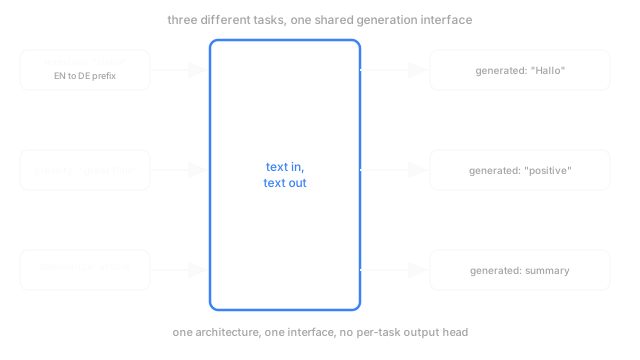
T5 reframes every NLP task as text in, text out, so classification becomes generating a label word instead of building a separate output head per task.
Why Does This Exist?
Before T5, building an NLP system meant building several different systems. A translation model had an encoder plus a decoder that generates a sentence. A classification model had an encoder plus a small linear layer that outputs one of a fixed set of labels. A named-entity tagger had yet another head, predicting a tag per token. Each task got its own output shape, its own loss, and often its own architecture tweak, because "translate a sentence" and "pick one of five labels" look like fundamentally different problems.
That's the wall: every new task needs a new output head, and every output head is bespoke plumbing that has to be designed, trained, and maintained separately, even when the underlying encoder-decoder architecture doing the heavy lifting is identical. T5 — Text-to-Text Transfer Transformer, from a 2019 Google paper — removes the wall with one move: stop treating classification, regression, and generation as different kinds of output. Treat everything as text. The input is a string, the output is a string, always, whatever the task actually is.
Think of It Like This
One typist, every request phrased the same way
Picture an office where every request, no matter its actual purpose, has to go through one typist who only reads and types plain sentences. Ask her to translate a memo, and you type "translate this to French: ..." and she types back French. Ask her whether a customer review is positive or negative, and you type "sentiment: [the review]" and she types back the single word "positive" or "negative" — not a checkbox, not a form field, just a word, typed the same way she'd type anything else. Ask for a summary, and you phrase it as a request, and she types a shorter passage back.
The typist never learned a separate skill for each of these. She learned exactly one thing: read a passage of text, type a response. Every task that reaches her gets rephrased into that one shape before it arrives, and her actual output is always just more text — including when the "real" answer is a category rather than a sentence.
How It Actually Works
Every task becomes an input string, plus a prefix naming the job
T5 attaches a short natural-language prefix to the input so one model can tell tasks apart without any structural change: "translate English to German: That is good.", "summarize: <article text>", "cola sentence: The cat sat." for a grammar-acceptability check. The prefix is just more text, tokenized and fed in exactly like the rest of the input — there's no special "task ID" field, no branching code path. Whatever tells the model which job this is has to live inside the string itself.
The architecture underneath is an ordinary encoder-decoder
T5 is built on the full encoder-decoder architecture: an unmasked encoder reads the entire prefixed input, and a causally-masked decoder generates the output one token at a time, cross-attending into the encoder's representation at every layer. Nothing about that stack is new or task-text-specific — it's the same shape BERT's encoder half and GPT's decoder half are each one piece of. What changes between T5 and a plain translation model isn't the architecture; it's what gets fed in and what gets asked of the output.
Classification comes out as a generated label word
This is the piece that actually removes the wall. A sentiment classifier normally ends in a small linear layer mapping a hidden vector to a fixed number of classes — two numbers, softmaxed, done. T5 has no such layer anywhere. Instead, the decoder generates text one token at a time, same as it would for a translation, and the label itself is the generated text: the literal word "positive" or "negative," produced through the exact same next-token distribution the decoder always produces. There's no separate classification head to design, because the vocabulary already contains the words "positive" and "negative," and generating one of them is no different, mechanically, than generating any other word.
One model, one loss, mixed training data across tasks
Because every task's target is now a string, every task's loss is the same one — the standard cross-entropy over next-token predictions in the decoder. That lets T5 train on translation examples, summarization examples, and classification examples in the same batches, under the same objective, without any task-specific loss term or task-specific layer to route between. The training signal that used to be split across several different output shapes now flows through one.
Code
A minimal illustration of the classification-as-generation trick: restrict the decoder's output distribution to just the label tokens, and the argmax over that smaller set is the "classification."
import numpy as np
def softmax(logits: np.ndarray) -> np.ndarray: shifted = logits - logits.max() return np.exp(shifted) / np.exp(shifted).sum()
rng = np.random.default_rng(0)vocab_size = 10logits = rng.normal(size=vocab_size) # one score per vocabulary tokenlabel_token_ids = np.array([3, 7]) # token ids for "negative"=3, "positive"=7
full_probs = softmax(logits)print(full_probs.argmax()) # -> 6 -- an unrelated token wins over the full vocabulary
label_probs = softmax(logits[label_token_ids])winner = label_token_ids[label_probs.argmax()]print(winner) # -> 7 -- "positive" wins once generation is restricted to label wordsNothing here is a classifier in the traditional sense — it's the same decoder, the same softmax over the vocabulary, just read out through the two tokens that happen to spell the labels.
Watch Out For
Assuming the model 'knows' it's classifying
T5 has no internal notion of task type distinct from the string it was handed. If the prefix is ambiguous or the label vocabulary overlaps with plausible free text, the model can generate something that's neither label — a paraphrase, a hedge, an unrelated word — because nothing structurally forces the output into the closed set. Production systems built on this framing usually still validate or constrain the output, rather than trusting generation alone to stay inside the label set.
Confusing the text-to-text framing with the architecture itself
The text-to-text idea and the encoder-decoder architecture are two separate design decisions that happen to ship together in T5. A decoder-only model can adopt the same framing — feed it a prompt, read a generated label back out — without any encoder at all. Crediting "text-to-text" for architectural choices that actually belong to the encoder-decoder stack underneath is a common mix-up when comparing T5 to decoder-only LLMs doing the same trick.
The Quick Version
- T5 treats every NLP task — translation, classification, summarization — as generating a string from a string, with no per-task output head.
- A short text prefix tells the model which task this is; there's no separate task-ID mechanism.
- The architecture underneath is an ordinary encoder-decoder, unrelated to the text-to-text framing itself.
- Classification is generation restricted to a small set of label words, scored through the same decoder softmax as anything else.
- One shared loss across every task lets mixed-task data train in the same batches.