CTC Loss (Connectionist Temporal Classification)
When transcribing speech, some people talk fast and some talk slow. CTC Loss allows a neural network to output the exact same text word regardless of how much the audio stretches or compresses over time.
Why Does This Exist?
In Automatic Speech Recognition (ASR), a neural network analyzes a continuous audio spectrogram and outputs predictions at fixed intervals, for example, every 20 milliseconds.
If someone says the word "CAT" very slowly, the network might predict: C C C A A A A T T.
If they say it very quickly, it might predict: C A T.
Both audio clips mean exactly the same thing. How do we train a neural network to realize that C C C A A A A T T and C A T should both map to the ground-truth target text "CAT"? Historically, researchers had to manually chop up the audio and label exactly which millisecond the 'C' started and ended. This was incredibly tedious and prevented the creation of massive datasets.
CTC (Connectionist Temporal Classification) solved this entirely. It is a mathematical algorithm that automatically figures out the alignment between the input audio and the output text, allowing models to be trained "end-to-end" without requiring humans to manually timestamp the training audio.
Think of It Like This
The Repeating Telegram
Imagine a telegram operator sending a message over a faulty wire. To ensure the message gets through, they just hold down the button for each letter for a few seconds.
They send: H H H E E E L L L L L L O O O.
You know the word is "HELLO". Your brain naturally collapses the repeating H, E, and O.
But wait, how do you handle the double 'L' in "HELLO"? If you just collapse everything, you get "HELO".
To fix this, the operator agrees to pause (send a Blank) between repeated letters if they are actually supposed to be a double letter.
They send: H H E E E L L L (pause) L L L O O.
Now you know for sure it's "HELLO". This is exactly how CTC works.
How It Actually Works
CTC introduces a very specific set of rules for decoding the neural network's frame-by-frame predictions into a final text string.
1. The Blank Token ()
CTC expands the model's vocabulary by adding one special character: the "Blank Token" (often denoted as or _). This token does not mean a space between words; it means "no character is being spoken right now" or "transitioning between characters."
2. The Collapsing Rules
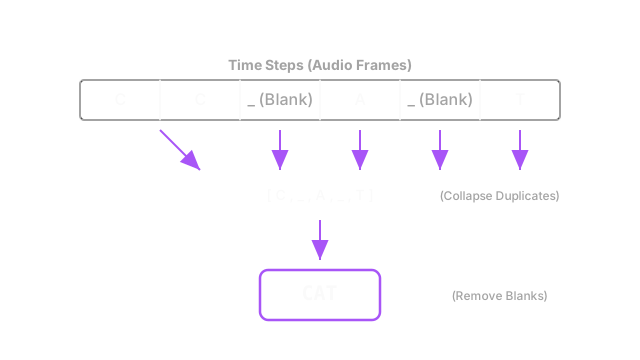
When the neural network outputs its prediction for every audio frame, we apply two strict rules to collapse it into the final text:
- Collapse Duplicates: Any identical characters that are right next to each other are merged into a single character.
C C C A A TC A T
- Remove Blanks: All Blank tokens are deleted.
C _ A A _ TC A _ TC A T
3. Handling Double Letters
The Blank token is what allows CTC to spell words like "APPLE".
If the network outputs A P P P P L E, Rule 1 collapses the P's, resulting in "APLE". This is wrong.
To get "APPLE", the network must output a Blank token between the two P's.
If the network outputs A P P _ P P L E:
- Rule 1 (Collapse Duplicates):
A P _ P L E - Rule 2 (Remove Blanks):
A P P L E
4. The CTC Loss Function (Training)
During training, we know the input audio and we know the target text is "CAT". Because of the collapsing rules, there are thousands of valid ways the network could output "CAT".
(C A T, C C A T, _ C A _ T, etc.)
The CTC Loss function uses an algorithm (Dynamic Programming) to efficiently calculate the sum of the probabilities of all possible valid paths. It then updates the neural network to make the sum of those valid paths more likely. The model essentially learns to figure out the timing on its own!
Code
This code demonstrates the decoding phase of CTC. While the CTC Loss function during training is mathematically complex, the decoding logic used during inference is beautifully simple.
def ctc_decode(frame_predictions, blank_token='_'): """ Decodes a sequence of frame-by-frame predictions using CTC rules. """ # Example frame_predictions: ['C', 'C', '_', 'A', '_', '_', 'T', 'T'] # Rule 1: Collapse sequential duplicates collapsed = [] previous_char = None for char in frame_predictions: if char != previous_char: collapsed.append(char) previous_char = char # collapsed is now: ['C', '_', 'A', '_', 'T'] # Rule 2: Remove the blank tokens final_output = [] for char in collapsed: if char != blank_token: final_output.append(char) # final_output is now: ['C', 'A', 'T'] return "".join(final_output)
# print(ctc_decode(['A', 'P', 'P', '_', 'P', 'P', 'L', 'E'])) # Output: "APPLE"Watch Out For
Conditional Independence
A major drawback of CTC is that it assumes every audio frame is conditionally independent of the others. If the network is unsure if a word is "THE" or "TEA", it might output the 'T', but then output an 'E' and an 'A', creating nonsense like "TEA". Because CTC doesn't use a built-in Language Model to know that "TEA" doesn't make grammatical sense in the sentence, it relies purely on the acoustics. Modern systems (like Whisper) use Sequence-to-Sequence Attention instead of CTC, which implicitly acts as a language model to fix grammatical mistakes.
The Quick Version
- Speech recognition models output predictions at fixed time intervals, causing slow speech to result in repeating characters (e.g.,
C C C A A T T). - CTC solves this alignment problem by providing two simple decoding rules: collapse all repeating characters, and delete all "Blank" tokens.
- The Blank token is crucial for spelling words with double letters (e.g.,
P _ Pcollapses toPP). - During training, the CTC Loss function mathematically sums up the probabilities of every single valid alignment, allowing the model to learn without needing humans to manually timestamp the audio data.
- While revolutionary, pure CTC models struggle with grammar and context, leading to their eventual replacement by Attention-based architectures in state-of-the-art models like Whisper.