Emergent Abilities
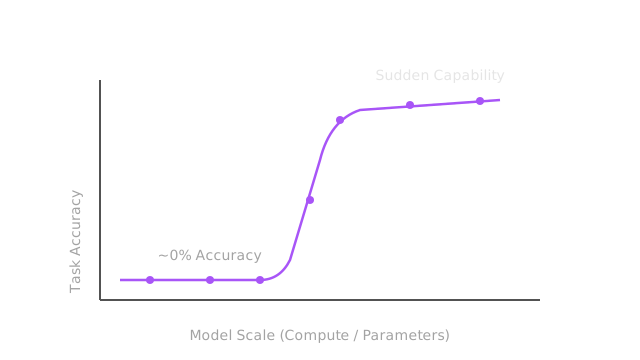
Models sometimes suddenly acquire complex new skills—like arithmetic or logical deduction—only after passing a massive threshold of compute and scale, despite no specific training for those skills.
Why Does This Exist?
Scaling laws give researchers comfort: if you pour 10x more compute into a model, its overall loss (its raw ability to guess the next token) will improve by a smooth, predictable, mathematically guaranteed amount. But overall loss is an average across trillions of tokens. It doesn't tell you what the model is actually capable of doing.
When researchers started testing these increasingly massive models on specific, complex tasks—like three-digit addition, translating proverbs, or writing Python code—they noticed something terrifying and exhilarating. The performance didn't improve smoothly. A 1-billion parameter model would score 0%. A 10-billion parameter model would score 0%. A 50-billion parameter model would score 0%. And then, suddenly, a 100-billion parameter model would score 80%.
These sudden, discontinuous leaps in capability are called emergent abilities. They exist because certain complex tasks cannot be partially solved; you either have the cognitive capacity to hold all the necessary pieces in context and combine them correctly, or you fail completely.
Think of It Like This
A child learning to ride a bicycle
Imagine tracking a child's progress learning to ride a bike. You measure their muscle strength, their balance, and their pedaling speed. These underlying metrics improve smoothly and predictably over months of practice (just like a model's scaling laws and overall loss).
However, if you measure their actual ability to ride 50 feet without falling, the graph looks completely different. For months, their success rate is exactly 0%. They fall every time. Then, one Tuesday, the underlying skills cross a critical threshold, everything clicks, and their success rate instantly jumps to 100%. The ability to ride a bike emerged suddenly, even though the underlying physical development was smooth.
How It Actually Works
The illusion of smooth scaling
To understand emergence, you have to separate the model's fundamental objective (next-token prediction) from the human-defined benchmarks we use to grade it (like the MMLU or GSM8K).
A small model might attempt to solve 145 + 322. It correctly identifies that it needs to do addition, and it guesses the first digit 4 correctly, but gets the rest wrong. Its "loss" improves slightly because it was closer than a totally random guess. But on a multiple-choice benchmark, a partially correct answer is still a wrong answer. The benchmark records a 0%. Only when the model gets large enough to chain all the necessary steps together perfectly does the benchmark register a success, creating the illusion of a sudden jump from nothing to mastery.
The debate: Is emergence real?
In 2023, a highly influential paper argued that emergent abilities might just be a "mirage" caused by how researchers choose to measure success. If you grade a math test using strict "exact match" scoring (it's either perfectly right or completely wrong), the graph looks like a sudden, emergent jump. But if you grade that exact same test using "partial credit" (giving points for getting the first few steps right, or measuring the Brier score of the token probabilities), the graph smooths out into a predictable, continuous curve.
This debate remains central to AI safety. If emergence is real, then scaling up a model might suddenly unlock dangerous capabilities (like the ability to design bioweapons) with zero warning. If emergence is just an artifact of strict grading, then researchers should be able to detect the early, partial signs of those capabilities long before they become dangerous.
Predictable overall, unpredictable specifically
The current consensus is a middle ground. The overall intelligence of the model (measured by loss) improves smoothly. However, because humans care about complex, multi-step workflows that require near-perfect execution (like writing a working web app), the practical utility of the model will always feel like it arrives in sudden, emergent leaps. You cannot predict exactly which scale will suddenly unlock a specific skill, which is why model evaluation remains an empirical, trial-and-error science.
Code
You can simulate the math behind the "mirage" of emergence by comparing a continuous, smooth improvement in underlying probability against a strict pass/fail threshold.
import matplotlib.pyplot as pltimport numpy as np
# Simulate a smooth, predictable increase in the model's underlying # probability of getting a single step of a 5-step problem right.model_scale = np.linspace(1, 100, 100)single_step_prob = 1 / (1 + np.exp(-(model_scale - 50) / 10)) # Smooth sigmoid
# If a task requires 5 steps, the model must get ALL 5 right.# The probability of exact success is (single_step_prob)^5exact_match_accuracy = single_step_prob ** 5
# Notice how the exact match accuracy stays near 0 for a long time,# then suddenly spikes upward, even though the underlying probability # was growing smoothly the entire time.for scale in [10, 40, 50, 60, 90]: step_p = single_step_prob[scale] exact_p = exact_match_accuracy[scale] print(f"Scale {scale}: Step Prob {step_p:.2f} -> Exact Match: {exact_p:.2f}")
# -> Scale 10: Step Prob 0.02 -> Exact Match: 0.00# -> Scale 40: Step Prob 0.29 -> Exact Match: 0.00# -> Scale 50: Step Prob 0.52 -> Exact Match: 0.04# -> Scale 60: Step Prob 0.75 -> Exact Match: 0.24 <-- Sudden jump begins# -> Scale 90: Step Prob 0.98 -> Exact Match: 0.91 <-- Massive capabilityBecause the complex task requires chaining multiple probabilities together, the overall accuracy remains suppressed until the underlying probability crosses a critical threshold.
Watch Out For
Assuming small models will eventually learn it
If a 7B parameter model has a 0% success rate on a complex logic benchmark, fine-tuning it on logic data will rarely solve the problem. Emergent abilities are fundamentally tied to parameter count and the sheer cognitive capacity to hold complex states in the activations. If the model lacks the "brain size" to cross the threshold, no amount of targeted fine-tuning will unlock the ability.
Relying on emergence for product features
Never build a product feature assuming that "the next generation model will surely be able to do this." Because emergent abilities are unpredictable by definition, you cannot guarantee that GPT-5 or Llama 4 will suddenly master the specific, niche workflow your startup relies on. Always build around the capabilities that have already reliably emerged.
The Quick Version
- Emergent abilities are complex skills that smaller models fail at completely, but larger models suddenly master with high accuracy.
- They occur because complex tasks (like math or coding) often require chaining multiple steps perfectly; partial success registers as a 0% on most benchmarks.
- There is a fierce debate over whether emergence is a fundamental property of neural networks or just a "mirage" caused by strict, non-linear grading metrics.
- Regardless of the cause, the practical reality is that model capabilities unlock unpredictably, making AI scaling both exciting and dangerous.