Measuring General Capability
When an AI can pass the bar exam, code like a senior developer, and write poetry better than a human, how do we actually measure how 'smart' it is? The old benchmarks are broken.
Why Does This Exist?
For decades, the "Turing Test" was the gold standard for Artificial Intelligence. If a human talking to an AI through a text chat couldn't tell it was a machine, the AI was considered "intelligent." Modern LLMs passed the Turing Test effortlessly, yet they still struggle to accurately count the number of 'r's in the word "strawberry."
This exposed a massive problem in AI research: we don't know how to measure intelligence.
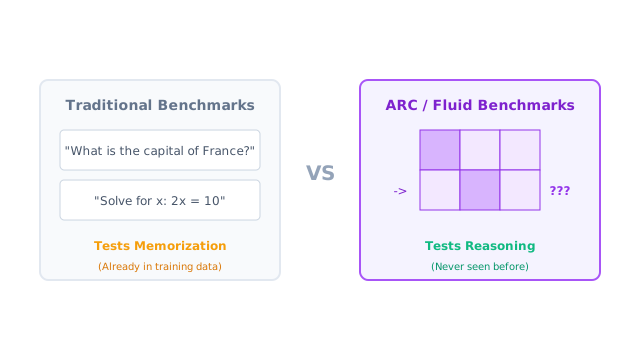
As we approach Artificial General Intelligence (AGI), our traditional benchmarks (like the SAT, the Bar Exam, or coding tests) are failing. They measure memorization, not reasoning. Measuring General Capability is the frontier of evaluation science: inventing new ways to objectively prove whether a model is actually thinking, or just regurgitating its training data.
Think of It Like This
Imagine a student taking an open-book history test. They get a 100%. Are they a genius historian, or did they just memorize the textbook?
To find out, you hand them a puzzle they have never seen before (e.g., "Design a new form of government for a colony on Mars based on these 3 principles"). If they succeed, they possess general capability (fluid reasoning). If they fail, they only possess narrow capability (memorization). Modern AI evaluation is trying to invent the Mars puzzle.
How It Actually Works
Researchers have shifted from static multiple-choice tests to dynamic, reasoning-based evaluations.
1. The ARC Benchmark (Abstraction and Reasoning Corpus)
Created by François Chollet, ARC is the leading benchmark for measuring true AGI. It consists of visual grid puzzles that require the AI to deduce a hidden rule (e.g., "fill in the enclosed shapes with blue") from 3 examples, and apply it to a new grid. Because the puzzles are uniquely generated and don't require external knowledge (like knowing who the 4th President was), it purely tests fluid intelligence and the ability to adapt to novel situations. To date, no AI has beaten the ARC benchmark without massive human assistance.
2. Interactive and Agentic Environments
Instead of asking an LLM a text question, researchers drop the AI into a simulated environment (like Minecraft, or a Linux terminal) with a complex goal (e.g., "Build a house" or "Find the bug in this codebase"). This measures long-horizon planning, tool use, and the ability to recover from unexpected errors—skills that define general capability in the real world.
3. Contamination Checking
A massive challenge in measuring capability is "Data Contamination." If an AI scores a perfect 100 on an advanced math benchmark, we have to prove that the benchmark wasn't accidentally included in the 10 Trillion words the AI was trained on. Advanced evaluation frameworks use cryptographic hashing or generate completely novel questions on the fly to prevent the AI from cheating.
Code
This conceptual code shows the difference between testing memorization (static) and testing fluid reasoning (dynamic/ARC style).
def evaluate_memorization(ai_model): # DANGEROUS: The AI probably saw this exact question in its training data. # Passing this does not prove intelligence. question = "What is the capital of France?" answer = ai_model.predict(question) return check_answer(answer, "Paris")
def evaluate_fluid_reasoning(ai_model): # Generate a completely novel, abstract puzzle that never existed on the internet # e.g., A custom grid transformation rule novel_puzzle, correct_output = generate_random_arc_task() # Give the AI 3 examples to figure out the underlying logic prompt = f"Examples: {novel_puzzle.examples}. Now solve this new input: {novel_puzzle.test_input}" answer = ai_model.predict(prompt) # If the AI gets this right, it proves true adaptability, not memorization. return check_answer(answer, correct_output)Watch Out For
Goodhart's Law
"When a measure becomes a target, it ceases to be a good measure." As soon as researchers release a new benchmark for AGI, AI companies immediately train their models specifically to beat that benchmark. The model gets a high score, but it hasn't actually become smarter; it just learned the test.
The Anthropomorphic Bias
We naturally assume that if an AI can do something hard (like pass a medical exam), it can automatically do something easy (like play tic-tac-toe). In AI, this is false. Capability is extremely "spiky." An AI can be a savant at quantum physics and simultaneously have the spatial reasoning of a toddler.
The Quick Version
- Standard AI benchmarks (like human exams) are broken because they measure memorization of training data, not true reasoning.
- To measure true Artificial General Intelligence (AGI), we must test fluid intelligence—the ability to learn novel concepts in real-time.
- The ARC benchmark is currently the gold standard for this, using abstract, novel visual puzzles that cannot be solved by memorization.
- The future of AI evaluation involves dropping agents into interactive environments (like software sandboxes) to measure their ability to plan, use tools, and recover from failure.