Energy and Efficiency of AI
Training a cutting-edge LLM consumes as much electricity as a small city. We cannot reach AGI by just plugging in more GPUs; we have to fundamentally rethink how AI uses energy.
Why Does This Exist?
In the early 2020s, the "Scaling Laws" proved that simply making a neural network bigger and giving it more data made it smarter. This kicked off a massive arms race to build the biggest GPU clusters in the world.
However, we are hitting a hard physical limit: electricity. A single training run for a frontier model (like GPT-4) can consume tens of gigawatt-hours (GWh) of electricity. A massive 100,000 GPU cluster requires roughly 150 Megawatts of power to operate—equivalent to the power draw of a medium-sized city. Furthermore, running these models in production (inference) for billions of users consumes even more energy over time.
We study the energy efficiency of AI because power availability, cooling capacity, and carbon emissions are now the primary bottlenecks to building smarter AI.
Think of It Like This
The Human Brain vs. The LLM
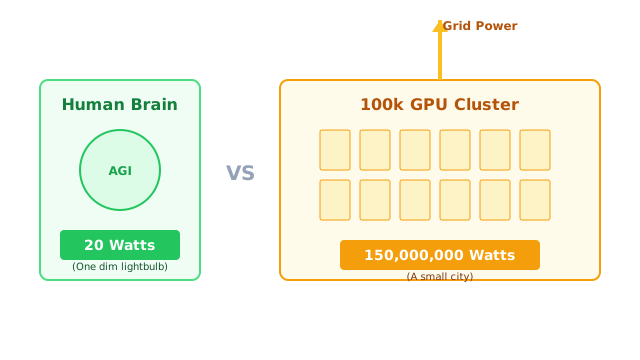
A human brain is the most advanced general intelligence on Earth. It operates on about 20 watts of power—roughly the same as a dim lightbulb.
A cluster of GPUs training an LLM operates on 150,000,000 watts of power, and it still isn't as smart as a human. The ultimate frontier of AI research isn't just making models smarter; it's making them smart efficiently.
How It Actually Works
Improving the energy efficiency of AI requires optimization across the entire stack, from the math to the power grid.
1. Algorithmic Efficiency
Standard Transformers are highly inefficient because they require every token to pay attention to every other token ( complexity). Researchers are inventing new math to lower this cost.
- Sparse Models (MoE): Instead of activating all 1 Trillion parameters for every word, Mixture of Experts models only activate the 10 Billion parameters that are relevant, cutting compute (and energy) drastically.
- Quantization: Storing neural weights in 4-bit numbers instead of 32-bit floats uses far less memory bandwidth, which is the primary source of power drain in a GPU.
2. Hardware Efficiency
GPUs were designed for rendering video games, not for AI. They are massively power-hungry. The industry is shifting toward specialized hardware:
- TPUs / NPUs: Tensor Processing Units are custom chips designed to do exactly one thing (matrix multiplication) as efficiently as physically possible.
- Neuromorphic Computing: Experimental chips designed to mimic the analog, spiking nature of the human brain, which could theoretically operate at millions of times the energy efficiency of digital GPUs.
3. Data Center Design
You cannot just plug 100,000 GPUs into a wall. The energy required to cool the GPUs often rivals the energy required to run them.
- AI data centers are moving toward Liquid Cooling (pumping coolant directly over the chips) rather than traditional air conditioning.
- Tech companies are investing in dedicated nuclear reactors (SMRs) and massive solar grids just to guarantee they have enough uninterrupted power to run the training clusters.
Code
While you don't write "energy" in code, you do monitor it. This snippet shows how to profile the energy consumption of an AI model using PyTorch and Nvidia's Management Library (NVML).
import torchimport pynvml # NVIDIA Management Library
def measure_energy_per_inference(model, input_data): pynvml.nvmlInit() handle = pynvml.nvmlDeviceGetHandleByIndex(0) # Measure power draw BEFORE running the model power_start_mW = pynvml.nvmlDeviceGetPowerUsage(handle) # Run the model (Inference) with torch.no_grad(): output = model(input_data) # Measure power draw DURING/AFTER running power_end_mW = pynvml.nvmlDeviceGetPowerUsage(handle) pynvml.nvmlShutdown() # Very rough estimation of power delta delta_watts = (power_end_mW - power_start_mW) / 1000.0 return f"Model consumed approximately {delta_watts}W during execution."Watch Out For
Jevons Paradox
In economics, Jevons Paradox states that making a resource more efficient actually increases its total consumption, because it becomes cheaper to use. Making AI 10x more energy efficient often results in companies training models that are 100x larger, resulting in a net increase in total energy consumption.
Carbon Offsetting Flaws
Many tech companies claim their AI is "Carbon Neutral" because they buy Renewable Energy Certificates (RECs) or plant trees. However, if the local power grid where the AI is actually training runs on coal, the AI is physically emitting massive amounts of carbon, regardless of what the accounting spreadsheets say.
The Quick Version
- AI capability scales with compute, but we are hitting physical limits on the electricity required to power and cool massive GPU clusters.
- The human brain uses ~20W of power, while AI clusters use ~150,000,000W, highlighting a massive gap in architectural efficiency.
- Researchers are optimizing energy through algorithmic changes (Sparsity, Quantization), specialized chips (TPUs, Neuromorphic), and advanced data center cooling.
- Energy and power availability is arguably the single largest physical bottleneck to achieving Artificial General Intelligence (AGI).