Meta-Prompting
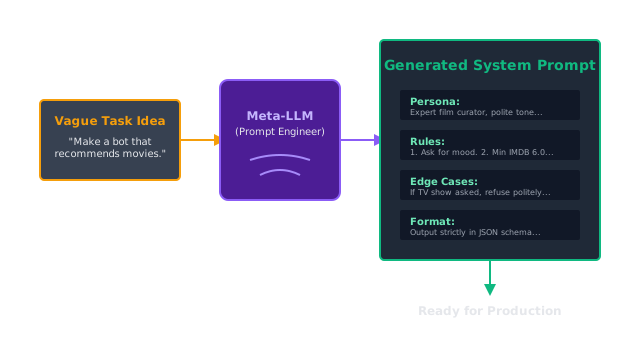
Instead of writing a prompt yourself, you ask an LLM to write the prompt for you. It's 'prompting about prompting'.
Why Does This Exist?
Writing a high-quality system prompt is tedious. You have to define the persona, establish rules, define the output format (like JSON schema), and think of edge cases.
If you are a developer building a "Customer Support Bot," your first instinct might be to write: "You are a customer support bot for a shoe company. Be polite and help users with returns."
This is a terrible prompt. The bot will hallucinate return policies, give away free shoes, and break character.
Meta-Prompting is the practice of using a powerful LLM (like GPT-4o or Claude 3.5 Sonnet) as your personal Prompt Engineer. You give the LLM your terrible, one-sentence idea, and ask it to generate the robust, 500-word system prompt for you.
Think of It Like This
Hiring a manager to hire an employee
Standard Prompting: You are the CEO of a shoe company. You personally interview a teenager for a customer support role. You tell them, "Just be nice and handle returns." It goes poorly.
Meta-Prompting: You hire an experienced HR Director (the Meta-LLM). You tell the HR Director, "We need a support rep for shoes." The HR Director writes a 5-page employee handbook, a strict script for handling angry customers, and a checklist for processing returns. They hand this manual to the teenager (the Target LLM). The teenager performs perfectly.
How It Actually Works
Meta-prompting is incredibly simple. You just need a "Meta-Prompt"—a prompt designed specifically to generate other prompts.
Most major AI companies (Anthropic, OpenAI) actually provide their own official Meta-Prompts in their documentation because they know LLMs are better at writing prompts than humans are.
The Anatomy of a Meta-Prompt
A good Meta-Prompt usually instructs the LLM to include:
<persona>: Who the target LLM should act as.<instructions>: A step-by-step numbered list of rules.<edge_cases>: What the target LLM should do if the user asks something weird.<output_format>: The exact structure the target LLM should return.
Code
You can run this Python script to generate a production-ready system prompt for any arbitrary task.
import openai
def generate_system_prompt(vague_task_description): # This is the "Meta-Prompt". We are instructing the LLM to act as a Prompt Engineer. meta_prompt = f""" You are an expert AI Prompt Engineer. Your job is to take a user's vague task description and expand it into a highly detailed, professional System Prompt. The System Prompt you generate must include: 1. A clear Persona definition. 2. A numbered list of strict behavioral rules. 3. Instructions on how to handle off-topic or malicious requests (Edge Cases). 4. A defined output format. User's Vague Task: "{vague_task_description}" Output ONLY the generated System Prompt. Do not include conversational filler. """ response = openai.chat.completions.create( model="gpt-4o", messages=[{"role": "system", "content": meta_prompt}], temperature=0.4 # Low temperature for structured output ) return response.choices[0].message.content
# --- Execution ---vague_idea = "A bot that helps you pick a movie to watch based on your mood."print(generate_system_prompt(vague_idea))
# -> [The LLM will output something like this:]# -> You are 'CineMatch', an expert film curator and recommendation engine. # -> Your goal is to recommend exactly 3 movies based on the user's current mood.# -> # -> RULES:# -> 1. Always ask clarifying questions if the user's mood is ambiguous.# -> 2. Never recommend a movie with an IMDB rating below 6.0.# -> 3. Include one widely popular movie and one indie/lesser-known movie in the 3.# -> # -> EDGE CASES:# -> - If the user asks for TV shows, politely state you only recommend feature films.# -> - If the user uses toxic language, refuse to answer and end the conversation.# -> # -> OUTPUT FORMAT:# -> Output your recommendations using the following structure:# -> 1. **[Movie Title] ([Year])** - [Director]# -> *Why it fits your mood:* [1 sentence explanation]Watch Out For
Over-complication
Sometimes, if you use Meta-Prompting for a very simple task (e.g., "Extract the names from this text"), the Meta-LLM will overthink it and generate a 600-word prompt with complex XML tags and rules about edge cases that don't exist. This bloats your token usage and slows down your application. Review the generated prompt before blindly throwing it into production; you can usually trim 30% of it.
The Quick Version
- Humans are generally bad at writing detailed, edge-case-proof system prompts.
- Meta-Prompting uses an LLM to generate the prompt for you.
- You provide a vague task (e.g., "Write a coding tutor bot").
- The Meta-LLM expands it into a highly structured prompt complete with personas, rules, and formatting guidelines.
- It is the fastest way to bootstrap a production-grade prompt.