World Models
To navigate the real world, an AI needs more than pattern matching; it needs an internal physics engine that predicts what will happen next if it takes a specific action.
Why Does This Exist?
Large Language Models are excellent at predicting the next word in a sequence, but they often fail at physical reasoning or long-term planning because they lack an internal representation of how the physical world works.
If you drop a glass on a tile floor, you instantly know it will shatter, and you know not to step there. You don't need to actually drop the glass to learn this; you have an internal "world model" that simulates the physics. For AI agents to operate in complex environments (like self-driving cars or robotics), they cannot rely on trial-and-error in the real world (Model-Free RL), because errors are expensive or fatal. They need a World Model to simulate the consequences of their actions internally before acting.
Think of It Like This
Imagine you are playing chess blindfolded.
You cannot see the board. To win, you must maintain a perfect mental representation of where every piece is. When your opponent says "Knight to C3," you don't just memorize the words; you update your mental board. When deciding your next move, you simulate moving your Bishop in your head and predict how your opponent will respond.
That mental chessboard is a World Model. It is an internal simulation of the external environment that allows you to plan and predict without looking.
How It Actually Works
A World Model typically consists of three distinct neural network components working together:
1. The Vision/Sensory Model (V)
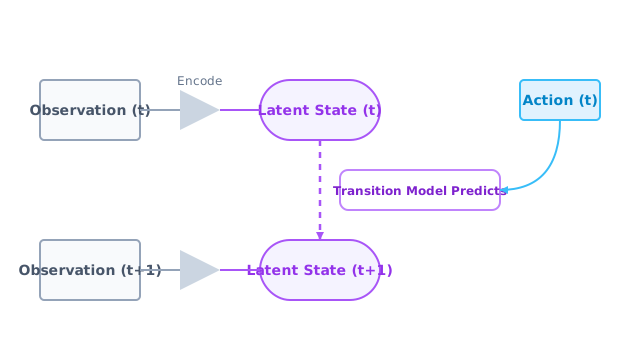
The environment is too complex to simulate at the pixel level. The sensory model (often an Autoencoder or a CNN) takes high-dimensional raw observations (like video frames or camera feeds) and compresses them into a low-dimensional, abstract latent representation. It extracts the "concepts" (e.g., a car, a pedestrian) and ignores the noise (e.g., the exact shadow on a leaf).
2. The Transition/Memory Model (M)
This is the core predictive engine, often implemented as an RNN, LSTM, or Transformer. It takes the current compressed state from the Vision model, plus the agent's proposed action, and predicts the next compressed state. It answers the question: "If the world looks like X right now, and I do action Y, what will the world look like in the next moment?"
3. The Controller/Actor (C)
This is the policy network that actually decides what action to take. Instead of training the Controller in the real, physical environment (which is slow and dangerous), you train it entirely inside the "dreams" or simulations generated by the Transition Model. The agent explores billions of possibilities in its own head.
JEPA (Joint Embedding Predictive Architecture)
A modern approach to world models, championed by Yann LeCun, is JEPA. Instead of predicting the exact pixels of the future (which is computationally wasteful since most pixels, like the sky, don't matter), JEPA predicts the abstract representation of the future. It focuses on the semantic changes rather than the visual noise, making the world model much more efficient and robust.
Code
This conceptual code shows how an agent uses a world model to plan in latent space before taking an action.
def plan_action_with_world_model(current_observation, possible_actions, vision_model, transition_model, reward_model): """ The agent simulates the future in its 'mind' to choose the best action, without taking any physical action yet. """ # 1. Compress the raw observation into a latent state current_state = vision_model.encode(current_observation) best_action = None highest_expected_reward = -float('inf') # 2. Simulate the future for each possible action for action in possible_actions: # Predict the next state in latent space (The 'Physics Engine') predicted_next_state = transition_model.predict(current_state, action) # Evaluate how good that predicted future is predicted_reward = reward_model.evaluate(predicted_next_state) if predicted_reward > highest_expected_reward: highest_expected_reward = predicted_reward best_action = action # 3. Only execute the best action in the real world return best_actionWatch Out For
Compounding Errors
Because the Transition Model is an approximation, its predictions have a small margin of error. If you use the model to simulate 100 steps into the future, those tiny errors compound. By step 50, the AI's internal simulation might look completely alien compared to reality, leading to catastrophic plans.
The Pixel-Prediction Trap
Trying to build a world model that predicts the exact future pixels of a video feed is a trap. The model will waste all its compute trying to predict the exact texture of rippling water or rustling leaves, rather than understanding the physics of the boat moving through the water. This is why latent-space prediction (like JEPA) is preferred.
The Quick Version
- A World Model is an AI's internal representation of the environment's physics and rules.
- It allows an agent to simulate the future consequences of its actions before taking them, enabling long-term planning without dangerous real-world trial and error.
- It compresses raw sensory data into abstract concepts, predicts how those concepts will change based on an action, and then chooses the best action.
- Predicting the future in abstract "latent space" (like JEPA) is much more efficient than trying to predict exact future pixels.