Zero-Shot Prompting
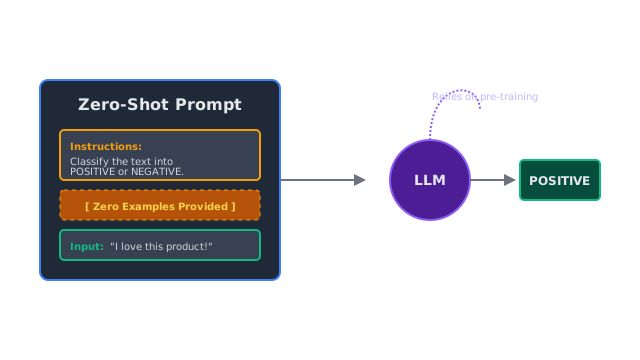
You give the LLM instructions and ask it to perform a task immediately, without providing any examples of what a 'correct' answer looks like.
Why Does This Exist?
In the early days of NLP, if you wanted an AI to translate English to French, you had to train a specific model on millions of English/French pairs. If you then wanted it to summarize text, you had to train a totally different model.
The breakthrough of modern Large Language Models (LLMs) is their ability to perform tasks they were never explicitly trained for, just by reading instructions.
Zero-Shot Prompting is the simplest way to interact with an LLM. You present a task (the "shot") without providing any prior examples (zero) in the prompt itself. You are relying entirely on the model's vast pre-training and instruction fine-tuning to deduce what you want.
Think of It Like This
The new employee's first task
Imagine hiring a brilliant new assistant who has read every book in the world but has never worked in your specific office.
Zero-Shot Prompting: You hand them a messy spreadsheet and say, "Organize this by date and highlight the rows from October." You don't show them how you normally organize spreadsheets; you just expect them to figure it out based on their general understanding of the words "organize," "date," and "highlight."
If the assistant is smart enough (a powerful LLM), they will do it perfectly on the first try.
How It Actually Works
Zero-shot prompting became viable with the advent of Instruction Tuning (also called RLHF - Reinforcement Learning from Human Feedback).
A "Base Model" (like the raw GPT-3 from 2020) was terrible at zero-shot prompting. If you prompted a base model with "Translate 'Hello' to French:", it might autocomplete the text with "Translate 'Goodbye' to Spanish:" because it was just predicting the next likely sentence in a list.
Modern models (like GPT-4o, Claude 3.5 Sonnet, Llama-3-Instruct) are heavily fine-tuned to act as helpful assistants. When they see a zero-shot prompt, they recognize the instructional intent and immediately attempt to fulfill the command.
When to use Zero-Shot
Zero-shot is ideal for:
- General knowledge retrieval: "What is the capital of France?"
- Formatting and translation: "Translate this text to JSON."
- Creative generation: "Write a poem about a server outage."
- Simple classification: "Is this review positive or negative?"
When Zero-Shot Fails
Zero-shot fails when the task requires a highly specific, non-standard output format, or when the logic is too convoluted for the model to guess without a demonstration. For example, if you want the model to classify a review, but your specific classification categories are "Promoter", "Detractor", and "Passive", a zero-shot prompt might output "Positive" instead of "Promoter" because it doesn't know your specific corporate vocabulary.
Code
Zero-shot prompts are what most people type into ChatGPT every day. Here is how it looks in an API call.
import openai
def zero_shot_classification(text): # Notice we provide instructions, but ZERO examples of what the output should look like. prompt = f""" Classify the sentiment of the following text as exactly one of: [POSITIVE, NEGATIVE, NEUTRAL]. Text: "{text}" Sentiment: """ response = openai.chat.completions.create( model="gpt-4o-mini", messages=[{"role": "user", "content": prompt}], temperature=0.0 # Low temperature for classification tasks ) return response.choices[0].message.content.strip()
print(zero_shot_classification("The battery life on this laptop is abysmal."))# -> NEGATIVEWatch Out For
Brittle Formatting
If you use a zero-shot prompt in a production data pipeline (e.g., asking for JSON output), the LLM might decide to add conversational filler: "Sure! Here is the JSON you requested: { ... }". This will immediately crash your json.loads() parser. If you cannot use strict structured outputs, you must move to Few-Shot prompting to teach the model to stop being conversational.
The Quick Version
- A "shot" is an example provided to the LLM.
- Zero-Shot prompting provides zero examples. You just write the instructions and expect the LLM to do it.
- It relies entirely on the model's pre-trained knowledge and instruction tuning (RLHF).
- It is great for simple, common tasks (translation, basic summarization) but fails when you need highly specific, idiosyncratic formatting or complex, multi-step logic.