Paper breakdown
Generative Adversarial Networks (GAN)
Introduced the GAN, an elegant framework where two neural networks—a generator and a discriminator—compete against each other to create hyper-realistic synthetic data.
Paper: Generative Adversarial Nets
Authors: Ian Goodfellow, Jean Pouget-Abadie, Mehdi Mirza, Bing Xu, David Warde-Farley, Sherjil Ozair, Aaron Courville, Yoshua Bengio · 2014
Read the paper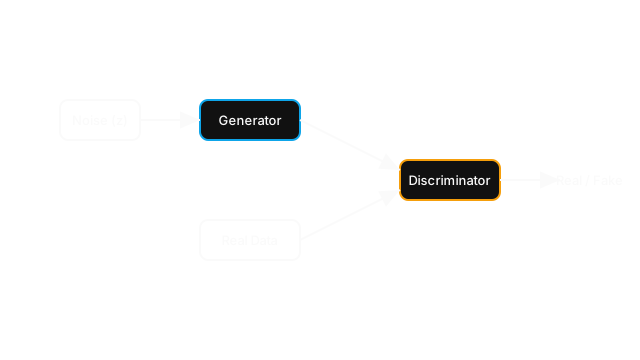
The Problem
Generative models (models that try to create new data, like images, rather than just classify it) were struggling. Existing methods relied on complex Markov chains or maximizing intractable likelihood functions, resulting in generated images that were blurry and unrealistic.
The Idea
Goodfellow proposed framing generative modeling as a game between two competing neural networks: a counterfeiter and a detective.
The Generator (the counterfeiter) tries to produce fake data that looks exactly like the real training data. The Discriminator (the detective) looks at both real data and the Generator's fake data, and tries to guess which is which.
How It Works
The two networks are trained simultaneously in a minimax game:
- The Generator takes random noise as input and outputs a fake image.
- The Discriminator takes an image (which could be real or fake) and outputs a probability (0 to 1) of it being real.
- The Discriminator's weights are updated to maximize its accuracy at catching fakes.
- The Generator's weights are updated to maximize the Discriminator's failure rate.
As training progresses, the Discriminator gets better at spotting flaws, which forces the Generator to create increasingly realistic images to fool it. At the theoretical optimum, the Generator's data is indistinguishable from reality, and the Discriminator's guess is always 50/50.
Why It Mattered
GANs produced the first genuinely sharp, high-resolution, photorealistic synthetic images in AI history. They spawned an entire subfield of research, leading to DeepFakes, StyleGAN, and early AI art. Yann LeCun famously called adversarial training 'the most interesting idea in the last 10 years in ML'.
What Came After
GANs dominated generative computer vision for over half a decade. However, they are notoriously difficult and unstable to train, prone to 'mode collapse' (where the generator just produces the exact same image over and over). By 2022, Diffusion Models (like Stable Diffusion) largely superseded GANs for high-resolution image generation because diffusion is much more mathematically stable to train.