Visual explainer
Pooling Layers
Small windows that keep one value per region shrink maps and forgive tiny shifts.
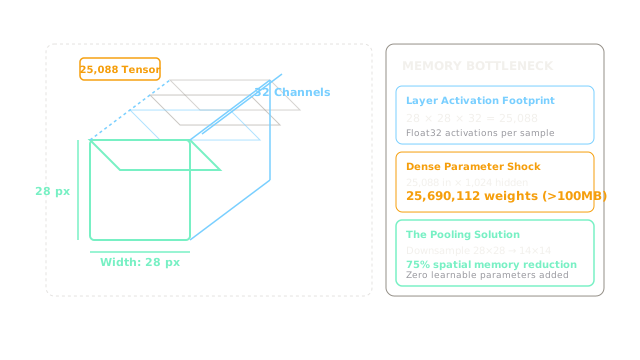
In deep convolutional networks, early feature extraction layers produce high-dimensional tensor volumes. Even a modest input image of pixels processed across feature map channels yields:
If these activations were flattened directly into a standard dense hidden layer with units, the linear weight matrix alone would explode to:
This memory footprint exhausts GPU cache and causes severe overfitting. Downsampling spatial dimensions is essential to scale network depth without exploding parameter counts.
Keep Strongest Only
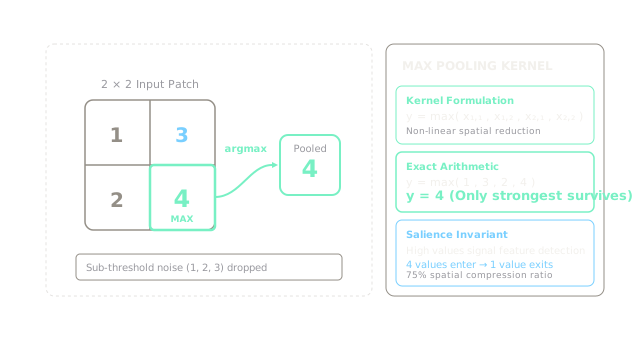
Max-pooling applies a non-linear subsampling window across each feature channel independently. For a receptive field :
Given candidate activations , the operator evaluates:
In convolutional representations, high numerical values signify the confident detection of a visual primitive (such as an oriented edge, textured corner, or color contrast). Max-pooling extracts this dominant feature presence while discarding sub-threshold background noise. Crucially, pooling introduces zero learnable parameters.
Quarter The Map
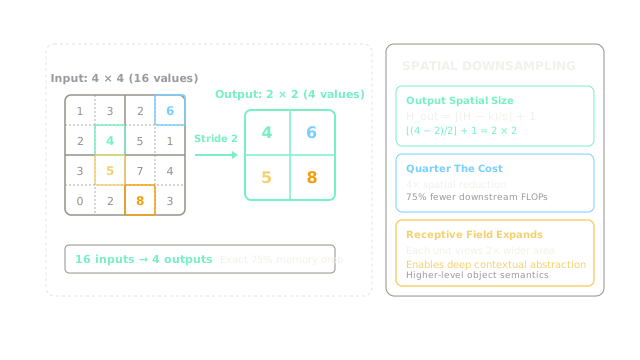
Setting the pooling stride equal to the window size () creates non-overlapping partitions across the entire grid. The output spatial dimensions follow:
Applied to a feature map (16 values), stride-2 pooling extracts the maximum value from each quadrant:
This operation compresses spatial memory by exactly (quartering the grid), allowing downstream layers to double channel capacity while simultaneously doubling the receptive field scale of subsequent filters.
Max Versus Average
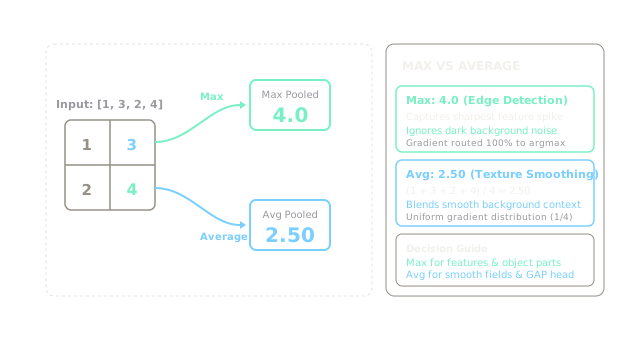
Max-pooling and average-pooling process the same input patch with fundamentally different mathematical objectives:
- Max Pooling (): Reports the extreme value . It preserves sharp boundaries and sparse feature spikes, routing of upstream gradients back strictly through the single coordinate during backpropagation.
- Average Pooling (): Computes the arithmetic mean . It smooths spatial variation, preserves background luminance, and distributes gradients uniformly ( to each unit).
Shifts Still Match
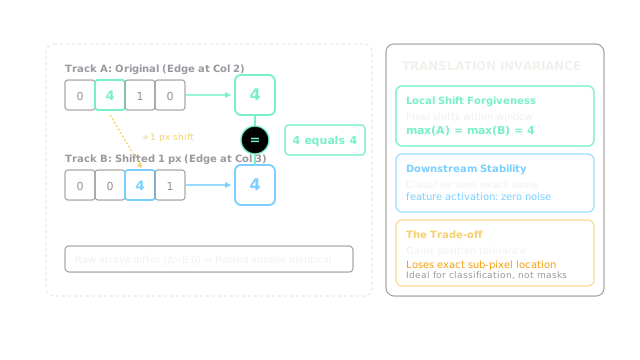
The defining architectural advantage of pooling is local translation invariance. Consider an edge feature that shifts one pixel horizontally between video frames:
While the raw input tensor differs completely (), the pooled output remains mathematically identical:
Small input displacements, tremors, and minor misalignments are absorbed by the pooling kernel, presenting downstream classification heads with a stable, invariant representation.
Pick Your Voice
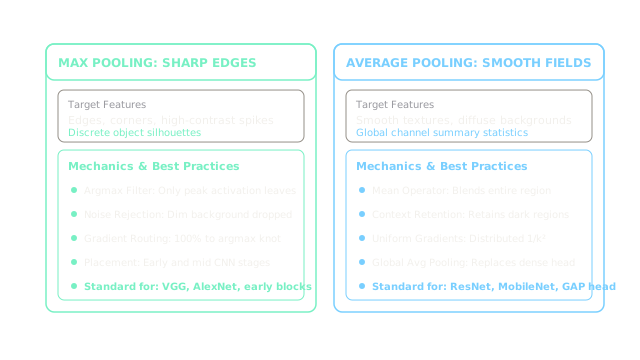
Modern deep learning architectures partition pooling operators by functional hierarchy:
- Max Pooling: Optimal for early and intermediate convolutional feature extractors (e.g. VGG, AlexNet, early ResNet blocks) where retaining sparse object edges and high-contrast foreground features drives discrimination.
- Global Average Pooling (GAP): Optimal for final classification heads (e.g. ResNet, MobileNet, EfficientNet). GAP averages each entire feature map into a single scalar, reducing the channel volume to a compact vector. This replaces multi-million-parameter flatten layers entirely, preventing overfitting and providing structural regularization.
Where It Breaks
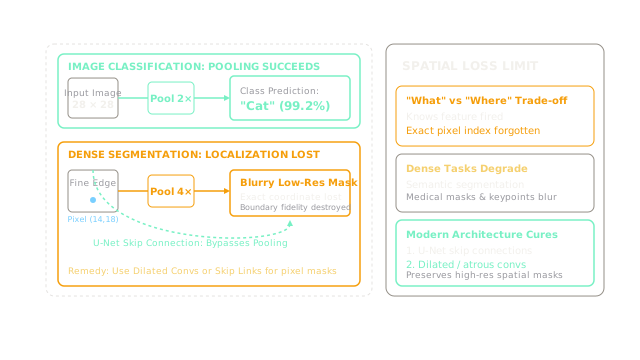
Translation invariance comes at a steep architectural cost: the destruction of precise spatial localization.
While a pooled network easily verifies that a feature fired, downsampling discards the exact pixel coordinates of that feature. For image-level classification ("is there a cat?"), this is ideal. But for dense pixel-prediction tasks—such as semantic segmentation (U-Net), medical boundary delineation, and object keypoint detection—pooling destroys boundary fidelity, resulting in blurry, blocky masks.
To overcome this limitation, architectures use:
- Skip Connections (U-Net): Routing high-resolution encoder feature maps directly across to the decoder, bypassing the pooling bottleneck.
- Dilated (Atrous) Convolutions: Expanding the filter receptive field with gaps, enabling broad context aggregation without sacrificing spatial resolution.
The Quick Version
- High-resolution convolutional feature maps () overwhelm dense layer parameter budgets.
- A max-pooling window keeps only the single strongest activation (4) and drops sub-threshold noise.
- Non-overlapping stride-2 pooling quarters spatial dimensions (), reducing FLOPs by .
- Max pooling preserves sharp edge spikes (), while average pooling smooths spatial fields ().
- One-pixel input shifts yield identical pooled answers (), providing local translation invariance.
- Max-pooling suits early feature extraction; Global Average Pooling replaces dense classification heads.
- Pooling destroys exact spatial coordinates, requiring skip connections or dilated convolutions for segmentation.