Skip to content
AI360Xpert
Core ML
Visual explainer

Convolutional Neural Networks

How alternating convolution and pooling layers form a pipeline that shrinks spatial dimensions while deepening feature representations.

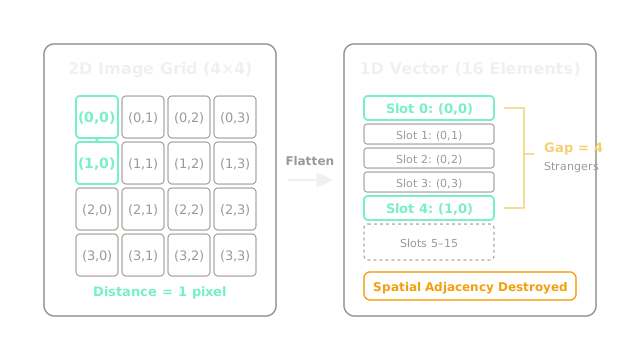
Flattening a 2D image into a 1D vector destroys the spatial relationships between neighboring pixels.

Images are grids, and a pixel's meaning comes entirely from its neighbors. Flattening that grid into a vector to feed a standard neural network destroys those proximity relationships, forcing the network to learn spatial structure from scratch without the geometry to help it.

Preserving Structure

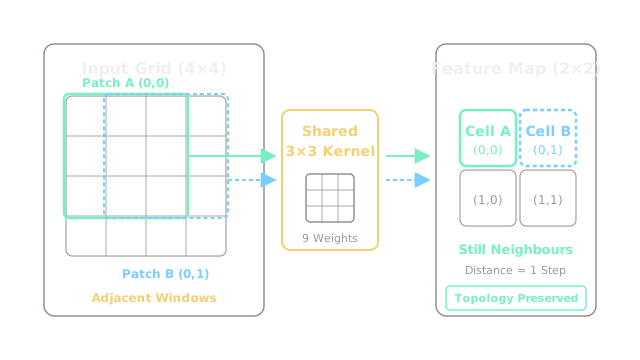
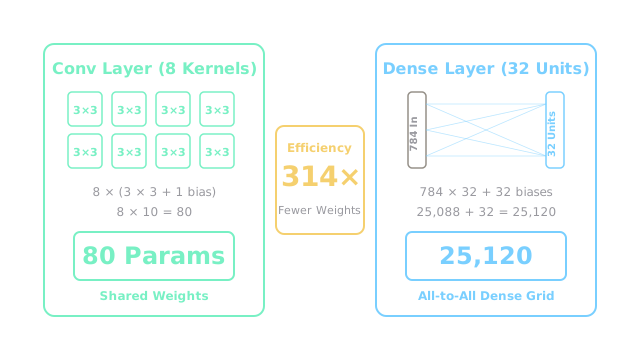
Convolution slides a small kernel across the image, mapping a patch of pixels to a single feature while preserving 2D structure.

Instead of flattening, a convolutional layer scans a small window across the image. It computes a local feature for each patch and outputs a new 2D grid. The spatial relationship between top-left and bottom-right is preserved, but now the grid holds extracted features rather than raw colors.

Shrinking the Map

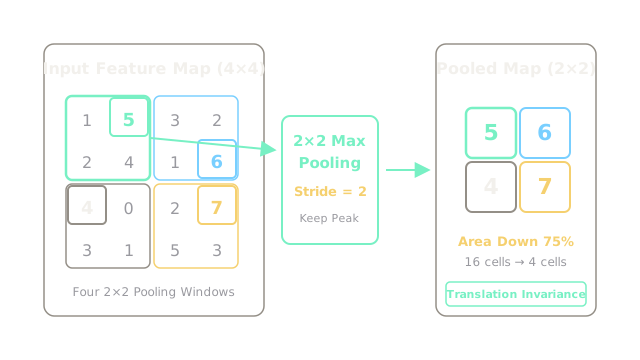
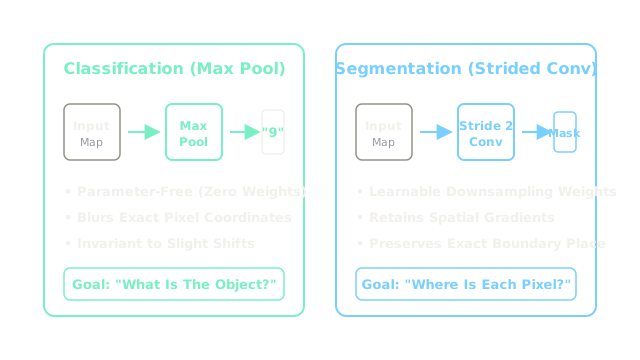
Pooling condenses a local patch into a single strongest signal, shrinking the map and adding tolerance to exact position.

A pooling layer follows the convolution. It takes a local neighborhood — usually a 2×2 block — and passes only the maximum value forward. This shrinks the spatial dimensions by half and makes the network slightly invariant to exactly where a feature appeared in the original input.

The Deep Pipeline

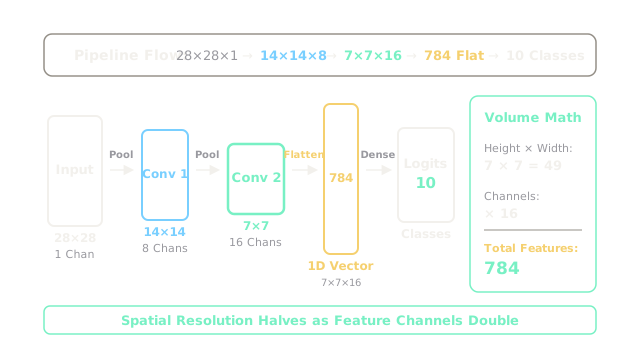
The repeating block shrinks spatial dimensions but deepens channel count, trading pixel location for richer feature representation.

A Convolutional Neural Network (CNN) stacks these blocks in sequence. As the data flows deeper, repeated pooling shrinks the width and height, while repeated convolutions increase the channel depth. The network systematically trades spatial resolution — "where exactly is it?" — for feature richness — "what exactly is it?". Only at the very end is the small, deep volume flattened into a vector for classification.

Feature Hierarchy

Because of this architecture, earlier layers automatically learn simple edges, while deeper layers learn complex data-specific patterns.

This shape forces a natural division of labor. Early layers, looking at small local patches of the original pixels, learn to detect simple edges and corners. Middle layers combine those edges into textures and simple parts. Deep layers, reading the composite output, respond to complete, complex objects specific to the dataset.

Where It Breaks

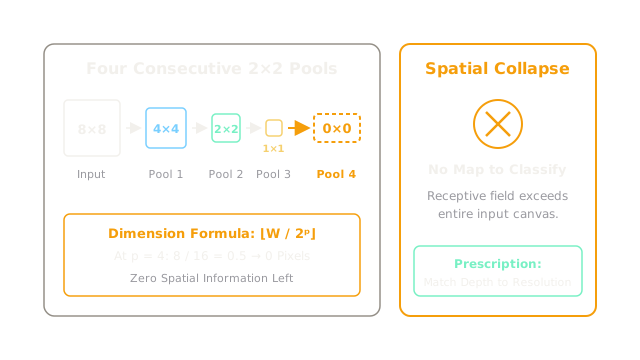
Downsampling too aggressively shrinks the spatial map to a single pixel before meaningful patterns can form, breaking the pipeline.

The architecture fails if downsampling outpaces feature extraction. If a small input image is pooled too many times, the spatial dimensions collapse to a single pixel before the network has built enough depth to represent the data. The structure is destroyed prematurely, and the model cannot learn.

The Quick Version

  • Flattening images destroys their inherent 2D spatial relationships.
  • Convolution preserves geometry by scanning local patches into feature maps.
  • Pooling shrinks the maps, saving compute and adding positional tolerance.
  • The pipeline systematically trades spatial resolution for feature depth.
  • The network naturally learns a hierarchy from simple edges to complex shapes.
  • Extreme downsampling on small inputs destroys structure before features form.

What to Read Next