Benchmark Saturation
When a model approaches the absolute upper limit of a test's score, the test loses its ability to measure progress or distinguish between competing models.
Why Does This Exist?
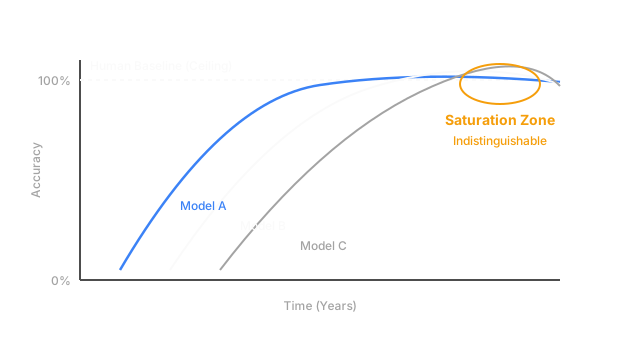
In the early days of a machine learning discipline, researchers publish a benchmark to measure progress. For example, ImageNet was published to measure computer vision, and SQuAD was published to measure reading comprehension. Initially, models score terribly (e.g., 40% accuracy). Over the next few years, as architectures improve, scores climb steadily: 60%, 75%, 85%.
Eventually, the models get so good that they score 98% or 99%. At this point, the benchmark has reached saturation.
When a benchmark is saturated, it is no longer a useful scientific instrument. If Model A scores 98.2% and Model B scores 98.4%, you cannot conclude that Model B is smarter. The remaining 1.6% of errors are usually not genuine mistakes by the model; they are noise. They are misspelled questions in the test set, ambiguous phrasing, or incorrect ground truth labels created by human annotators. When models operate in the saturation zone, they are not competing on capability—they are competing on who can better memorize the dataset's noise.
Think of It Like This
Think of It Like This
Think of benchmark saturation like giving a 3rd-grade math test to a room full of university mathematics professors.
If you grade the test, almost every professor will score a 99% or a 100%. If one professor scores a 99% because they misread a poorly printed fraction, and another scores a 100%, you cannot scientifically conclude that the second professor is better at calculus.
The test is completely saturated. It is far too easy for the subjects taking it, meaning its resolving power has dropped to zero. To figure out which professor is actually the best mathematician, you have to throw the 3rd-grade test away and write a much harder exam.
How It Actually Works
Benchmark saturation is a natural, unavoidable lifecycle for any static evaluation suite. It forces the AI community to constantly invent new, harder benchmarks. Understanding saturation requires recognizing the difference between the human baseline and the theoretical ceiling.
The Human Baseline vs. The Ceiling
Most benchmarks are created by humans, and therefore they contain human error. If a team of expert annotators takes the test and scores a 95% due to fatigue or subjective disagreements, that 95% is the human baseline.
The theoretical ceiling is the maximum possible score achievable on the test if you factor in the noise. If 3% of the test questions have objectively wrong answers in the answer key, the theoretical ceiling is 97%.
When a model crosses the human baseline and approaches the theoretical ceiling, the benchmark is saturated. Any further "improvements" on that test are mathematically meaningless.
The Lifecycle of a Benchmark
- Publication: A benchmark is released. It is too hard for current models.
- The Climb: Over 2-3 years, researchers optimize architectures and algorithms, climbing the curve rapidly.
- Saturation: Models hit the 90%+ range. The remaining errors are predominantly dataset noise.
- Obsolescence: The benchmark is quietly abandoned by serious researchers, though marketing departments may continue to cite it because a 99% score looks impressive on a press release.
Combating Saturation
To fight saturation, the industry employs several strategies:
- Dynamic Benchmarks: Instead of a static CSV file, the benchmark is constantly updated with new, harder questions.
- Adversarial Filtering: Humans or other models intentionally try to write questions that current state-of-the-art models fail, guaranteeing that the benchmark remains difficult.
- LLM-as-a-Judge: Moving away from static multiple-choice questions (which are easy to saturate) toward open-ended generation graded by a stronger model.
Show Me the Code
You can programmatically detect if your internal evaluation suite is approaching saturation by analyzing the variance in scores across multiple recent model iterations. If the variance collapses and the scores bunch up near the human baseline, it is time to retire the test.
import numpy as np
def detect_saturation( recent_model_scores: list[float], human_baseline: float, threshold: float = 0.02) -> bool: """ Detects if an evaluation benchmark is saturated. Returns True if models are clustered tightly near the baseline. """ if len(recent_model_scores) < 3: return False # Not enough data mean_score = np.mean(recent_model_scores) variance = np.var(recent_model_scores) # 1. Are models close to the human baseline? near_ceiling = (human_baseline - mean_score) < threshold # 2. Have scores stopped moving? (variance collapse) stalled_progress = variance < (threshold ** 2) if near_ceiling and stalled_progress: print(f"WARNING: Benchmark saturated at {mean_score:.1%}.") return True return False
# scores = [0.981, 0.985, 0.982, 0.988]# human_baseline = 0.99# -> detect_saturation(scores, human_baseline) -> TrueWatch Out For
Optimizing for Noise
If your team continues to set OKRs against a saturated benchmark, engineers will eventually resort to destructive behavior to get the score up. They will hardcode rules to bypass poorly phrased questions, or they will overfit the model to the specific biases of the annotators who wrote the test. This increases the benchmark score but degrades the model's actual performance in the real world.
Marketing Over Science
Be highly skeptical of product announcements that claim superiority based on a 1% win on a benchmark from three years ago. In 2026, claiming a win on a 2023 benchmark like MMLU or GSM8K is scientifically meaningless, because those tests have been saturated and contaminated for years. Look for evaluations on fresh, private, or adversarial datasets.
The Quick Version
- Benchmark saturation occurs when models reach the performance ceiling of a test, usually in the high 90s.
- Once saturated, a benchmark can no longer distinguish between a good model and a great model.
- The remaining errors on a saturated test are almost entirely noise: mislabeled data, ambiguous questions, or typos.
- Optimizing against a saturated benchmark harms real-world performance because it forces the model to learn the noise.
- The only solution to saturation is to discard the old test and build a significantly harder one.
What to Read Next
benchmark-contamination— How models sometimes reach the saturation point artificially by memorizing the answers during training.evaluation-harness-design— How to swap out saturated datasets for fresh ones without breaking your testing pipeline.