Evaluation Harness Design
A systematic infrastructure that isolates models from datasets and metrics, ensuring that a score change is caused by the model, not the testing pipeline.
Why Does This Exist?
In the early stages of a machine learning project, evaluation often lives in a loose, ad-hoc script or a Jupyter notebook. A practitioner loads a local dataset split, iterates over it with a raw model.predict() call, and passes the results to a library function like accuracy_score or a custom string-matching function. This works for a quick sanity check, but it breaks down completely when a team tries to compare different model iterations, reproduce a historical result, or deploy the system to production.
When someone claims "the new model is 3% better," you need to know exactly what that means. Did they test it on the exact same holdout set, or did the data sampling change? Did they use the same prompt template for the generative model? Did the parsing logic that extracts the final answer from the model's output change slightly to forgive a formatting error the new model makes? If the evaluation pipeline is just a script on a laptop, you cannot confidently answer these questions.
An evaluation harness exists to lock down every moving part of the testing process except the model itself. It is a dedicated software system that standardizes how inputs are fed to a model, how the model's outputs are parsed, and how those outputs are compared against ground truth. By enforcing a rigid separation of concerns, the harness guarantees that if a metric changes, the model actually caused it.
Think of It Like This
Think of an evaluation harness as a dynamometer in an automotive testing facility.
If you want to know which engine produces more horsepower, you do not let the engineers drive their cars around a track and self-report the results. The weather, the tires, the driver's mood, and the track surface would all contaminate the data.
Instead, you bolt the engine to a dynamometer. The dynamometer feeds a precise, controlled mixture of fuel and air. It applies a standardized, reproducible load, and it uses calibrated sensors to measure the output power. The dynamometer (the harness) remains completely fixed and standardized; only the engine (the model under test) changes.
How It Actually Works
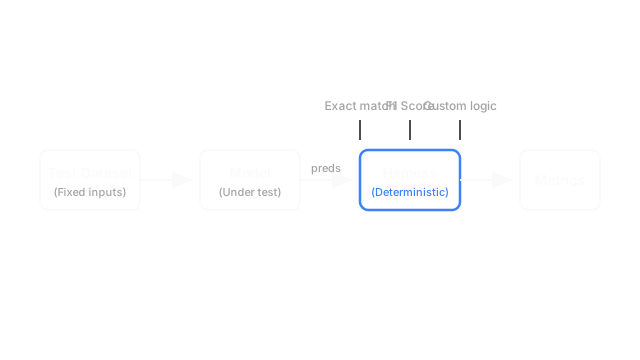
At its core, an evaluation harness standardizes three separate interfaces: the dataset registry, the execution engine, and the scoring registry. This strict separation of concerns prevents the most common evaluation errors, such as data leakage or silent changes to the grading criteria.
The Dataset Registry
A harness never loads data from a loose CSV file or an unstable API. It pulls evaluation sets from a versioned registry. When a test run is initiated, the harness fetches a specific, immutable version of the dataset. This ensures that every model is graded against the exact same distribution of edge cases, standard examples, and negative samples.
If the dataset needs to be updated (for example, to include newly discovered failure modes from production), the harness creates a new version. This allows older model scores to remain reproducible against the older data version, while new models can be tracked against the updated benchmark. A strong dataset registry also prevents train-test contamination by structurally separating evaluation data from the training pipelines.
The Execution Engine
The execution engine is responsible for standardizing how the model is invoked. This is particularly critical for generative models and large language models (LLMs), where small formatting changes in the input can drastically alter the output.
The harness enforces a strict schema for prompts and system instructions, ensuring that the model receives precisely the intended context. It manages the concurrency of requests, handles rate limits or timeouts, and catches inference errors gracefully so that a single malformed prediction does not crash the entire evaluation suite.
Crucially, the execution engine also separates the raw generation from the parsing logic. If an LLM is asked to output a JSON object, the harness attempts to parse the JSON using a deterministic, shared function before passing the extracted value to the scorer. This prevents the model's prediction logic from being entangled with the post-processing logic.
The Scoring Registry
Scorers are standalone, deterministic functions that compare the parsed output against the ground truth. A harness maintains a library of versioned scorers.
Instead of writing custom logic for every experiment, practitioners declare which scorers they want to use: exact match, F1 score, semantic similarity, or a custom domain-specific metric. The harness applies these scorers uniformly across the parsed outputs. This prevents a very common failure mode where an engineer subtly alters the grading logic—for example, by adding a .lower() or .strip() call—to make their new model appear artificially better than the baseline.
Code
Here is a simplified Python representation of how an evaluation harness processes a run. Notice how the three core components are strictly decoupled.
from typing import Callable, Dict, Any, List
def run_evaluation_harness( model_inference_fn: Callable[[str], str], dataset: List[Dict[str, Any]], scorers: Dict[str, Callable[[str, str], float]]) -> Dict[str, float]: """ Executes a strict evaluation pipeline to guarantee reproducible metrics. """ results = {metric_name: [] for metric_name in scorers.keys()} for example in dataset: input_text = example["input"] ground_truth = example["target"] # 1. Standardized Execution (with parsing) try: raw_output = model_inference_fn(input_text) parsed_output = raw_output.strip() except Exception: parsed_output = "" # 2. Deterministic Scoring for metric_name, scorer_fn in scorers.items(): score = scorer_fn(parsed_output, ground_truth) results[metric_name].append(score) # 3. Aggregation return { metric: sum(scores) / len(scores) for metric, scores in results.items() }
# -> {'exact_match': 0.85, 'f1_score': 0.89}Watch Out For
Silent Metric Drift
If your scorers are not rigorously versioned, someone will eventually update the f1_score or exact_match function to handle a newly discovered edge case. Suddenly, all historical evaluation runs are incomparable to new runs, destroying the integrity of your benchmark. Treat your scorers as immutable code; if the grading logic must change, create a new scorer entirely, such as f1_score_v2.
Over-optimizing for the Harness
When the harness becomes the single source of truth for model quality, teams will inevitably optimize their models to excel at the specific prompts and parsing logic enforced by the harness. This can lead to models that score exceptionally well in the lab but fail in production because the real-world usage patterns drift away from the harness's rigid schemas.
The Quick Version
- An evaluation harness is robust infrastructure that standardizes the testing of machine learning models to guarantee reproducibility.
- It completely decouples the model under test from the dataset, the prompt templating, and the scoring logic.
- Datasets are versioned and immutable, ensuring a level playing field for every single model iteration.
- Scorers are deterministic functions applied uniformly across all test examples, preventing ad-hoc grading changes that inflate scores.
- The ultimate goal is metric integrity: a metric should only move if the model's underlying capability has genuinely changed.