Bias and Fairness
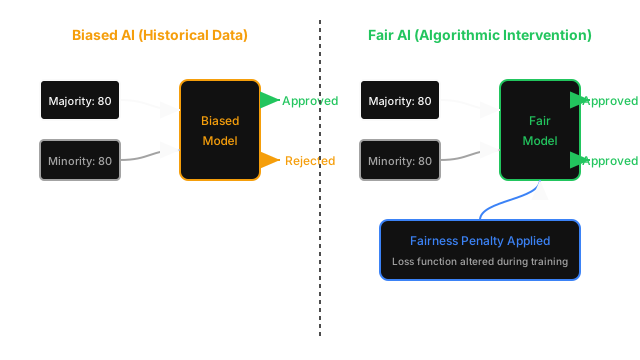
Machine learning models mathematically encode the human biases present in their training data. Mitigating this requires algorithmic interventions to ensure the model's predictions do not unfairly discriminate against protected groups.
Why Does This Exist?
There is a dangerous myth that because AI is based on math, it must be objective. This is completely false. Machine learning models do exactly one thing: they find statistical correlations in the data you feed them.
If you train a model on 50 years of historical banking data to predict who will default on a loan, and that historical data contains human prejudice (e.g., bank managers unfairly denying loans to minorities), the AI will learn that being a minority is highly correlated with being denied a loan. The AI will then mathematically perfectly replicate that racism.
Bias and Fairness in AI is the engineering discipline of identifying these encoded prejudices (Algorithmic Bias) and altering the training data, the algorithm, or the outputs to ensure the model treats all groups equitably.
Think of It Like This
A mirror reflecting a messy room
Imagine you hold a mirror up to a room that is incredibly messy and disorganized.
If you take a picture of the mirror, the resulting photo will show a messy room. You cannot blame the mirror—it just perfectly reflected what was in front of it.
An AI model is a mirror held up to human society. If society's historical data contains sexism, racism, or classism, the AI will reflect it back to us. Fixing the mirror requires us to either clean up the room before taking the picture (Data Pre-processing) or use Photoshop to fix the image afterward (Output Post-processing).
How It Actually Works
Where Does Bias Come From?
- Historical Bias: The world itself is biased, and the data perfectly captures it (e.g., NLP models associating the word "Doctor" with men and "Nurse" with women because historically, that was the statistical majority).
- Representation Bias: The dataset does not accurately reflect the real world. If you train a facial recognition system only on photos of white college students, it will have drastically higher error rates when trying to identify people of color.
- Proxy Variables: You might think you removed bias by deleting the "Race" column from a dataset. However, the model will simply use a combination of "Zip Code," "Income," and "Education" as a mathematically perfect proxy for race.
Defining "Fairness" (The Impossible Math)
There is no single mathematical definition of fairness. In fact, computer scientists have proven that the three most common definitions of fairness are mutually exclusive; you literally cannot satisfy all three at once.
- Demographic Parity: The model should approve the same percentage of applicants from every group (e.g., 20% of men get loans, 20% of women get loans).
- Equal Opportunity: The model should have the same True Positive Rate across all groups. If someone is genuinely qualified for a loan, they should have an equal chance of being approved regardless of gender.
- Equalized Odds: The model should have both the same True Positive Rate and False Positive Rate across all groups.
Interventions
If a Red Team discovers a model is biased, developers intervene at three stages:
- Pre-processing: Reweighting the training data so minority groups have an equal statistical impact on the loss function.
- In-processing: Changing the loss function during training to penalize the model if its predictions correlate too heavily with a protected attribute like race.
- Post-processing: Mathematically shifting the final decision thresholds for different groups to force demographic parity before the output is shown to the user.
Code
# A conceptual look at In-processing fairness interventiondef train_fair_model(model, data, labels, protected_attributes, epochs=10): optimizer = torch.optim.Adam(model.parameters(), lr=0.01) for epoch in range(epochs): predictions = model(data) # 1. Standard accuracy loss (Be correct) accuracy_loss = compute_standard_loss(predictions, labels) # 2. Fairness penalty (Don't be biased) # We calculate how much the predictions correlate with the protected attribute (e.g. Gender) # If the model uses gender to make its decision, the correlation will be high. correlation = compute_correlation(predictions, protected_attributes) fairness_penalty = correlation * 5.0 # Weight the penalty # 3. The model must balance being accurate with being fair total_loss = accuracy_loss + fairness_penalty optimizer.zero_grad() total_loss.backward() optimizer.step()Watch Out For
The Accuracy vs. Fairness Tradeoff
If historical data shows that Group A defaults on loans more than Group B, forcing a model to approve them at the exact same rate (Demographic Parity) will inherently lower the overall accuracy of the model. The model will be forced to approve unqualified members of Group A and deny qualified members of Group B just to hit the fairness quota. This tradeoff requires a policy decision, not just an engineering one.
Blindness does not equal fairness
As mentioned above, removing "protected attributes" (like race or gender) from the dataset does not make the model blind to them. The model will find proxies. In fact, many fairness algorithms require you to keep the protected attributes in the dataset so the model can actively measure its own bias and adjust against it.
The Quick Version
- AI models inherit and amplify the human biases present in their training data.
- Bias often stems from unrepresentative datasets or historical societal prejudice.
- Merely removing variables like "Race" or "Gender" from a dataset does not stop bias, as the model will find mathematical proxies.
- There is no single definition of mathematical fairness (e.g., Demographic Parity vs. Equal Opportunity), and choosing one often reduces the model's absolute accuracy.
- Bias must be actively mitigated by altering the dataset, changing the loss function during training, or adjusting the final decision thresholds.