Calibration
A highly accurate model can still be a dangerous liar if it claims to be 99% confident when it's actually guessing. Calibration measures whether a model's stated confidence matches its true accuracy.
Why Does This Exist?
In the early days of Machine Learning, researchers only cared about one metric: Accuracy. If a model got 95% of its predictions right, it was considered ready for production.
But when deep neural networks entered the real world—diagnosing diseases and driving cars—a terrifying problem emerged. Modern neural networks are highly accurate, but they are systematically uncalibrated.
When a modern deep neural network outputs "I am 99.9% confident this is a dog," it is usually only right about 70% of the time. This massive gap between stated confidence and actual accuracy makes the model's confidence scores entirely untrustworthy, rendering downstream safety systems (like selective-prediction) useless. Calibration is the field of measuring and fixing this gap.
Think of It Like This
Imagine you have two friends, Alice and Bob, who give you stock tips.
Alice (Perfectly Calibrated): When Alice says she is "90% sure" a stock will go up, and you track her over a year, you find that exactly 9 out of 10 of those stocks went up. You can trust her words literally.
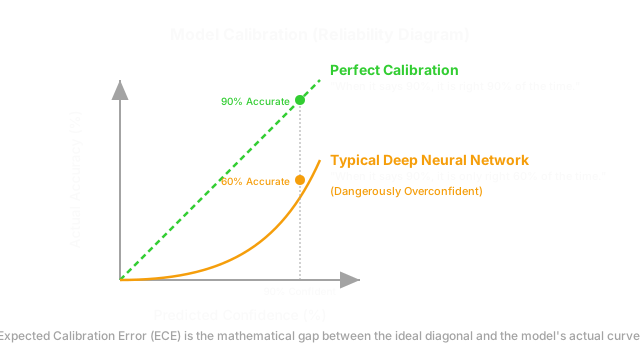
Bob (Overconfident): When Bob says he is "90% sure" a stock will go up, he is actually only right about 60% of the time. Bob might still be a decent stock picker overall (he's right more often than he's wrong), but his confidence is a lie. If you bet your life savings based on Bob's "90%" claim, you will go broke.
Modern deep neural networks act exactly like Bob.
How It Actually Works
To measure how badly a model is hallucinating its confidence, researchers use two primary tools: Reliability Diagrams and the Expected Calibration Error (ECE).
1. The Reliability Diagram
You take a validation dataset (e.g., 10,000 images) and run your model on all of them. You record the model's prediction and its confidence score for every image.
Then, you group the predictions into "bins" based on confidence.
- Bin 1: All predictions where confidence was between 90% and 100%.
- Bin 2: All predictions where confidence was between 80% and 90%.
- ...and so on.
Next, you calculate the Actual Accuracy for each bin. If you look at the 90-100% bin, and the model was only correct on 65% of those images, you plot a point at (X: 95%, Y: 65%).
When you connect the dots, you get a Reliability Diagram. If the line drops far below the perfect diagonal, the model is dangerously overconfident.
2. Expected Calibration Error (ECE)
You cannot automate safety with a graph. You need a single number. Expected Calibration Error (ECE) calculates the mathematical gap between the perfect diagonal line and the model's actual curve.
- An ECE of
0.00means perfect calibration. - An ECE of
0.15means the model's confidence is off by an average of 15%. This is considered very poor calibration.
Why Are Deep Networks So Overconfident?
In 2017, a seminal paper (On Calibration of Modern Neural Networks) proved that the deeper and wider a neural network gets, the worse its calibration becomes. This happens because networks are trained using Cross-Entropy Loss, which actively penalizes the model until it pushes its output probabilities as close to 100% as possible. The model learns that "higher confidence = lower loss", completely destroying its calibration in the process.
Code
Calculating ECE requires grouping your predictions into bins. Here is how you do it using NumPy.
import numpy as np
def expected_calibration_error(confidences, accuracies, num_bins=10): """ Calculates the ECE for a model. - confidences: Array of the model's predicted probabilities (e.g., 0.95) - accuracies: Array of 1s (Correct) or 0s (Incorrect) """ # Create bins (e.g., 0.0 to 0.1, 0.1 to 0.2, etc.) bins = np.linspace(0.0, 1.0, num_bins + 1) ece = 0.0 total_samples = len(confidences)
for i in range(num_bins): # Find all predictions that fall into this specific bin bin_lower = bins[i] bin_upper = bins[i+1] in_bin = (confidences > bin_lower) & (confidences <= bin_upper) num_in_bin = np.sum(in_bin) if num_in_bin > 0: # Average confidence in this bin avg_confidence = np.mean(confidences[in_bin]) # Actual accuracy in this bin actual_accuracy = np.mean(accuracies[in_bin]) # The gap between confidence and reality gap = np.abs(avg_confidence - actual_accuracy) # Weight the gap by how many samples were in the bin ece += (num_in_bin / total_samples) * gap return ece
# Example Output:# Expected Calibration Error: 0.14 (14% off on average. Needs fixing!)Watch Out For
ECE Can Be Gamed
ECE is highly sensitive to the number of bins you choose. If you choose 10 bins, you might get an ECE of 0.05. If you choose 100 bins on the exact same data, your ECE might shoot up to 0.15. Never compare the ECE of two models unless you are absolutely certain they were calculated using the exact same binning strategy and the exact same validation set.
The Quick Version
- Accuracy measures if a model is right. Calibration measures if a model knows when it is right.
- Modern deep neural networks are incredibly accurate, but notoriously uncalibrated (dangerously overconfident).
- A Reliability Diagram visually plots the model's stated confidence against its actual accuracy.
- Expected Calibration Error (ECE) is the single metric that quantifies the gap between confidence and reality.
- If a model is poorly calibrated, its probability scores are meaningless, breaking downstream safety filters.