The Cold Start Problem
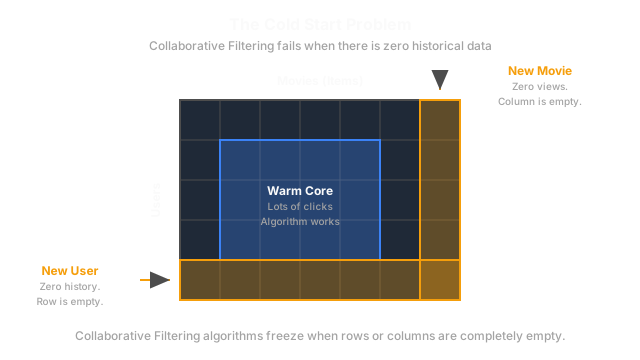
Machine learning recommenders rely on historical data. If a brand new user signs up, or a brand new product is added to the store, there is zero historical data. The algorithm completely freezes.
Why Does This Exist?
The most powerful recommendation algorithms in the world (Collaborative Filtering and Matrix Factorization) rely entirely on user behavior. They recommend items by finding overlapping patterns in how millions of users clicked, watched, and bought things.
This creates a paradox.
- To get recommendations, a movie needs to have been watched by lots of people.
- To be watched by lots of people, the movie needs to be recommended.
If you upload a brand new video to YouTube, it has 0 views. Because it has 0 views, the Collaborative Filtering algorithm mathematically cannot recommend it to anyone. Because it isn't recommended, it will stay at 0 views forever. This is the Cold Start Problem.
Think of It Like This
Think of It Like This
Imagine you get a job at a prestigious matchmaking agency.
Your job is to match clients based on their dating history. If John usually dates tall, introverted lawyers, you find him a tall, introverted lawyer. This is easy.
Then, a brand new client walks in. You have never met them. They have never dated anyone in your system. They refuse to fill out a questionnaire. How do you match them? You can't. You have absolutely no data to base your decision on. They are a "Cold Start" user. You just have to blindly send them on dates until you gather enough data to understand what they like.
Types of Cold Start
There are three distinct variations of the Cold Start problem, and they are solved differently.
1. New User Cold Start
A brand new user creates an account. They have no clicking history. How to solve it:
- Onboarding Surveys: Force the user to pick 5 topics they like when they first sign up (e.g., Netflix asking you to pick 3 movies you like).
- Demographics: If you know they are a 25-year-old male in Tokyo, you recommend the most popular items for 25-year-old males in Tokyo.
- Global Popularity: Just show them the Top 10 most popular items on the entire website until they click something.
2. New Item Cold Start
A brand new item is added to the catalog. Nobody has clicked it yet. How to solve it:
- Content-Based Filtering: Ignore user behavior entirely. If the new item is a "Horror Book by Stephen King", just recommend it to people who read "Horror Books by Stephen King". The model uses the metadata of the item, not the behavior.
- Forced Exploration: The system intentionally injects the new item into the Top 10 recommendations for a random subset of users. It sacrifices short-term accuracy to gather data on the new item quickly.
3. System Cold Start
You are launching a brand new startup today. You have 0 users and 0 items with any history. How to solve it:
- You cannot use Collaborative Filtering. You must use pure Content-Based Filtering or hardcoded business rules until you reach critical mass.
Code
Handling cold starts is usually an architectural routing problem, not a single mathematical algorithm. You write fallback logic to route cold users away from the heavy ML models.
def get_recommendations(user, new_item_catalog, all_time_popular_items): # 1. NEW USER COLD START if user.history_length == 0: if user.has_onboarding_data(): # Use their onboarding survey to do Content-Based matching return content_based_model.recommend(user.onboarding_preferences) else: # Absolute fallback: Just show them the most popular stuff globally return all_time_popular_items[:10] # 2. STANDARD USER (WARM) else: # Use our heavy Collaborative Filtering model recommendations = collaborative_filtering_model.recommend(user) # 3. NEW ITEM COLD START (Exploration) # We force 1 brand new item into the 4th slot of the carousel # so it gets views, allowing the CF model to learn about it tomorrow. random_new_item = get_random(new_item_catalog) recommendations.insert(3, random_new_item) return recommendations[:10]Watch Out For
The rich get richer.
If you do not explicitly solve the New Item Cold Start problem, your recommender system will fall into a feedback loop. It will only recommend the 100 most popular items. Because those items are recommended, they get more clicks, making them seem even more popular, guaranteeing they will be recommended again tomorrow. New items will be permanently buried. You must dedicate 5-10% of your recommendation slots to random exploration.
The Quick Version
- Recommender algorithms require historical data to function.
- The Cold Start Problem occurs when you have zero historical data for a new user or a new item.
- New Users are handled by forcing them to fill out onboarding surveys, or by showing them globally popular items.
- New Items are handled by using Content-Based filtering (matching on genre/tags) or by artificially injecting them into recommendations to force data collection.
- If you don't solve this, your system will only ever recommend the same popular items forever.