Collaborative Filtering
Recommending items to a user based on what similar users liked. It entirely ignores what the item actually is, focusing purely on the overlapping behavior of the crowd.
Why Does This Exist?
If you want to recommend a book to a user, the obvious approach is to look at the book's contents. If the user bought "Harry Potter 1", you recommend "Harry Potter 2" because they have the exact same author and genre. This is called Content-Based Filtering.
However, Content-Based Filtering struggles with serendipity. It will only ever recommend fantasy books. It will never realize that people who like Harry Potter also happen to like buying Lego sets.
Collaborative Filtering (CF) solves this by completely ignoring the content of the items. It doesn't know what a book is, or who wrote it. It simply looks at the collective buying behavior of millions of users. If 10,000 people who bought Book A also bought Item B, the algorithm links them together, regardless of what the items actually are.
Think of It Like This
Think of It Like This
Imagine you walk into a massive music store.
Content-Based Filtering: The store clerk looks at the AC/DC CD in your hand and says, "Oh, you like rock music with heavy guitars? Here is a Metallica CD."
Collaborative Filtering: The store clerk looks at the AC/DC CD in your hand and says, "I have no idea what genre that is. But the last 50 guys who walked in here holding that exact CD also bought this black leather jacket. You should buy the jacket."
How It Actually Works
There are two primary ways to calculate Collaborative Filtering.
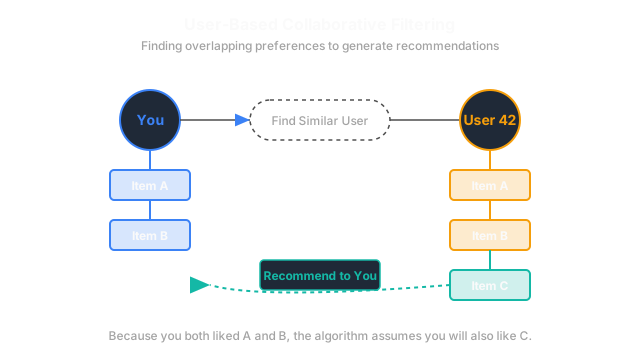
1. User-Based Collaborative Filtering (UBCF)
"Find users similar to me, and recommend what they liked."
- You liked Movies A, B, and C.
- The algorithm searches the database and finds "User 42", who also liked Movies A, B, and C.
- User 42 also liked Movie D.
- The algorithm recommends Movie D to you.
- Problem: Users are incredibly fickle and their tastes change daily. Also, in massive systems (like Amazon), calculating the distance between 300 million users in real-time is computationally impossible.
2. Item-Based Collaborative Filtering (IBCF)
"Find items similar to the items I like." Instead of comparing users, you compare items. If Movie A is frequently watched by the exact same group of people who watch Movie Z, then Movie A and Movie Z are mathematically "similar".
- You liked Movie A.
- The algorithm looks up the pre-calculated list of movies similar to Movie A (which includes Movie Z).
- The algorithm recommends Movie Z to you.
- Why it's better: Item relationships are much more stable than user relationships. Movie A and Movie Z will remain similar for years. Amazon famously invented and popularized Item-Based CF in 1998 because they could compute the item-to-item similarity matrix overnight, allowing for blazing-fast recommendations during the day.
Code
Classical collaborative filtering is essentially just calculating the Cosine Similarity between vectors in a User-Item matrix.
import pandas as pdfrom sklearn.metrics.pairwise import cosine_similarity
# 1. Create a simple User-Item Rating Matrix# 0 means they haven't watched it.data = { 'Batman': [5, 4, 0, 0, 1], 'Superman': [4, 5, 0, 0, 1], 'Barbie': [0, 0, 5, 4, 0], 'Oppenheimer':[0, 1, 4, 5, 0]}users = ['User 1', 'User 2', 'User 3', 'User 4', 'User 5']df = pd.DataFrame(data, index=users)
# 2. Calculate Item-Based Similarity (Transpose the dataframe first!)# This calculates how similar the MOVIES are to each other, based on who watched them.item_similarity = cosine_similarity(df.T)item_sim_df = pd.DataFrame(item_similarity, index=df.columns, columns=df.columns)
print("Item-to-Item Similarity Matrix:")print(item_sim_df.round(2))# Notice that Batman and Superman have a very high similarity score (0.97),# while Batman and Barbie have a score of 0.00.
# 3. Recommend for a new user# If a user likes Batman, what should we recommend?print("\nRecommendations if you liked Batman:")print(item_sim_df['Batman'].sort_values(ascending=False)[1:]) Watch Out For
The Cold Start Problem.
Because Collaborative Filtering relies 100% on historical user behavior, it fails completely when a brand new item is added to the catalog. If a movie was uploaded 5 seconds ago, nobody has watched it yet. Because it has no behavior history, Collaborative Filtering will never recommend it. You must use Content-Based filtering or random exploration to solve the Cold Start problem.
The Quick Version
- Collaborative Filtering recommends items based on the "wisdom of the crowd", completely ignoring item metadata (like genre or author).
- User-Based CF: Finds users with identical taste to you, and recommends what they liked. (Computationally expensive).
- Item-Based CF: Calculates which items are frequently bought together, and recommends items similar to what you just bought. (Much faster and more stable).
- It suffers heavily from the Cold Start problem—it cannot recommend items that have no historical interaction data.