Sparse Data and High Dimensionality
Two problems that show up together. Sparsity is about storage and statistics; dimensionality is about geometry, and it makes every distance look the same.
Why Does This Exist?
One-hot encode a column with 50,000 merchants and you get two problems in one object. People treat them as one and reach for one fix. Separating them is the work.
Sparsity is a storage and statistics problem. Most cells are zero — a fact about memory layout, and about how little evidence each column carries.
Dimensionality is a geometry problem. Too many columns relative to rows, and the space behaves in ways your two-dimensional intuition gets wrong.
A wide one-hot block gives you both, as do a document-term matrix and a user-item table. But a dense 512-dimensional embedding is high-dimensional and not sparse; a mostly-zero table with six columns is sparse and fine.
Think of It Like This
Asking a hundred people to rate a hundred films
Ask two people to rate one film out of ten. One says 9, the other 3. Six apart, and you know their taste exactly.
Now ask about a hundred films. Add up the disagreements and almost every pair lands in the same narrow band, because the big gaps and the small ones cancel. "Whose taste is closest to mine" has a clean answer at one film and a meaningless one at a hundred.
Two other things happened. Most people haven't seen most of the films, so the table is mostly empty. And there are possible profiles, against a hundred raters.
An empty table is a storage problem. Everyone the same distance apart is a geometry problem. Different fixes.
How It Actually Works
Sparsity is arithmetic
A sparse matrix stores only the non-zeros. CSR keeps three arrays — values, column indices, and a pointer marking where each row starts — so a row of 50,000 zeros costs almost nothing. CSC does the same by column.
Run the numbers: they decide whether the job runs. A matrix has cells, so dense float64 is 400GB. At 0.1% density that's 50 million non-zeros; CSR stores 12 bytes each plus a pointer per row, so about 604MB.
Three ordinary operations destroy that. Subtracting a column mean turns every zero into , so standardisation with centring asks for the 400GB — hence StandardScaler refusing sparse input unless you pass with_mean=False. .toarray() is the same, requested explicitly. Imputing the zeros with missing_values=0 overwrites every structural zero; those zeros meant "not this category".
There's a statistics half: a category in 12 rows out of a million gives its coefficient 12 rows of evidence, and you have 50,000 of them.
Dimensionality is geometry
Add columns and the volume grows exponentially while your row count sits still. The usual gloss is "the data gets sparse", which is true and not the part that hurts.
The sharp version: in high dimensions, distances become nearly equal. For a query point and a cloud of others, the ratio between the farthest distance and the nearest tends toward 1. Neighbours don't get further away; they stop being distinguishable from strangers. That breaks KNN, K-means, DBSCAN and any RBF kernel.
Two facts make it concrete. Take a unit hypercube and keep 0.05 clear of every face: in two dimensions that inner region holds of the volume, in a hundred it holds , or 0.0027%. Almost every point is jammed against a boundary. And the cosine between two random high-dimensional vectors has mean 0 with standard deviation about , so at a random pair is near-certain to sit within 0.1 of orthogonal.
Then the consequences. Sample complexity: covering a space to fixed resolution needs rows growing exponentially in . Overfitting: once columns outnumber rows, a linear model fits any label vector exactly, shuffled ones included. Rank deficiency: with the rank is at most , so an unregularised solve is ill-posed (vector spaces and rank).
What actually fixes it
Five options; you often want two. Select on frequency, variance or importance (feature selection). Project with PCA on dense data or TruncatedSVD on sparse (dimensionality reduction). Embed a short dense vector per category (vector embeddings). Regularise, since L1 and L2 make solvable. Change model: gradient-boosted trees take wide sparse input without complaint, because a split is a threshold on one column and never a distance.
Worked example
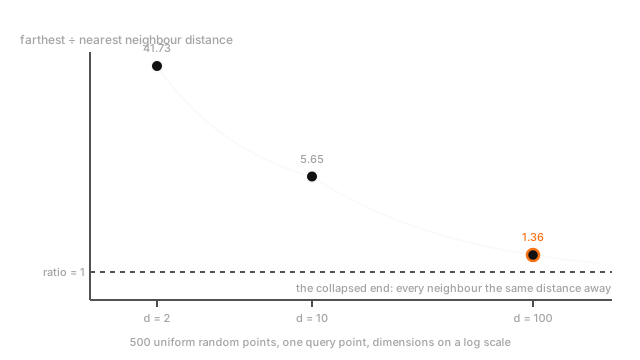
Draw 500 uniform random points, pick one query point, measure the farthest distance over the nearest. At 2 dimensions the ratio is 41.73: the nearest point is 40 times closer than the farthest. At 10 it's 5.65. At 100 it's 1.36 — the farthest of 500 points is only a third further away than the closest.
A KNN classifier then picks the five smallest of 500 numbers that sit within a third of each other. Noise decides the winners.
Code
import numpy as np
rng = np.random.default_rng(0)
def far_over_near(dim: int, n: int = 500) -> float: """Farthest over nearest distance, from one query point to n uniform random points.""" points = rng.random((n, dim)) query = rng.random(dim) d = np.linalg.norm(points - query, axis=1) return float(d.max() / d.min())
print(2, round(far_over_near(2), 2)) # -> 2 41.73print(10, round(far_over_near(10), 2)) # -> 10 5.65print(100, round(far_over_near(100), 2)) # -> 100 1.36Nothing changed but the width. The collapse from 41.73 to 1.36 is a property of the space, not anything you did wrong.
Watch Out For
Centring a sparse matrix and running out of memory
StandardScaler().fit_transform(X_sparse) raises a ValueError mentioning centring, and the reflex is .toarray() to make it go away.
That reflex turns a 604MB matrix into a 400GB allocation. Best case, MemoryError on a line that reads like housekeeping. Worse, the process swaps until the machine stops responding, with no traceback.
The error was right: centring destroys sparsity by definition, so it cannot be done in this format. Two fixes, both one argument. StandardScaler(with_mean=False) divides by the standard deviation and leaves zeros alone. MaxAbsScaler scales each column into by its largest absolute value, the usual choice for count data.
Trusting Euclidean neighbours on a very wide matrix
You build a recommender, one-hot a few high-cardinality columns, end up with 30,000 columns, and reach for KNN with Euclidean distance because it's the default.
It returns neighbours. It always returns neighbours. Look at the distances and they sit within a few percent of each other, so your top-5 is a ranking of noise. The give-away: precision@5 barely moves when you swap the model for random selection.
Two changes, in this order. Switch to cosine similarity, which compares direction rather than magnitude. Then reduce the width before measuring anything, so distances have room to differ again. Cosine in 30,000 raw dimensions helps; cosine in 200 projected dimensions is a working system. More in distance and similarity metrics.
The Quick Version
- Two problems, one object. Sparsity is storage and statistics; dimensionality is geometry. Fix them separately.
- A matrix is 400GB dense and about 604MB at 0.1% density in CSR.
- Centring,
.toarray()and imputing structural zeros each destroy sparsity. Usewith_mean=FalseorMaxAbsScaler. - The real damage in high dimensions is that distances become nearly equal: farthest over nearest tends to 1.
- Measured on 500 random points: 41.73 at two dimensions, 5.65 at ten, 1.36 at a hundred.
- At 100 dimensions only 0.0027% of a hypercube sits clear of its faces. Once columns outnumber rows, a linear model fits any labels exactly.
- Select, project, embed, regularise, or switch model. Trees cope with wide sparse input; distance methods don't.