Embodied AI and Robotics
Instead of an AI just outputting text on a screen, Embodied AI allows the model to output physical motor commands, giving the 'brain' of a Large Language Model a physical robotic 'body'.
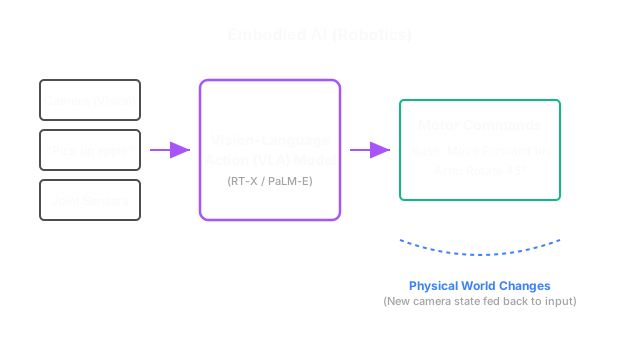
Why Does This Exist?
For a long time, AI and Robotics were almost entirely separate fields. If you wanted a robot arm to pick up an apple, a robotics engineer had to write hundreds of lines of complex math (inverse kinematics) just to calculate the exact angles of the robotic joints. If you moved the apple one inch to the left, the robot would fail.
Meanwhile, AI models like ChatGPT were incredibly smart, but they were trapped in a computer. They couldn't do anything in the physical world.
Embodied AI is the fusion of these two fields. It takes the advanced reasoning and visual understanding of a Vision-Language Model (VLM) and connects it directly to the motors of a robot. Instead of writing math to move the arm, you simply type "Pick up the apple," and the AI figures out how to move its body to make that happen.
Think of It Like This
The Brain in a Jar
A standard LLM is like a brilliant brain floating in a jar on a desk. You can pass it notes, and it can write brilliant essays back to you, but it can't lift a pencil or turn the page of a book.
Embodied AI takes that brain out of the jar and puts it inside a physical body. Now, when the brain decides it wants to read a book, it simply sends electrical signals to its new hands to pick up the book itself.
How It Actually Works
The architecture driving this revolution is called the Vision-Language-Action (VLA) Model, pioneered by models like Google's RT-2 (Robotic Transformer).
1. Unified Tokenization
A standard VLM predicts text tokens (e.g., the word "apple"). A VLA Model is trained on a third type of token: Action Tokens. Researchers define a dictionary of physical movements (e.g., Token 1000 means "Move arm forward 1cm", Token 1005 means "Close gripper 10%"). These action tokens are mixed perfectly into the language vocabulary.
2. The Multimodal Input
The robot has a camera in its head. The camera frame is passed through a Vision Encoder (like CLIP). The human speaks a command: "Throw away the trash." The VLA model takes the visual tokens of the room and the text tokens of the command, and fuses them together.
3. Autoregressive Motor Commands
The VLA uses its internal reasoning to realize: "The user wants to throw away trash. I see a crumpled piece of paper on the table. Therefore, I need to move my hand to the paper."
Instead of outputting English text, the model autoregressively outputs Action Tokens.
It outputs [Move Forward], and the robot physically moves forward. The camera takes a new picture, feeds it back into the model, and the model outputs [Close Gripper].
The model continuously "talks" to the robot's motors, guiding it through the physical world in real-time.
Code
This pseudocode shows the continuous loop of a VLA model controlling a physical robot. Notice how similar it looks to a standard chatbot loop, except it outputs motor commands instead of chat messages.
def run_robot_loop(vla_model, robot_hardware, user_command): """ Continuous control loop for an Embodied AI robot. """ print(f"Executing: {user_command}") while not robot_hardware.task_is_complete(): # 1. Look at the physical world camera_image = robot_hardware.get_camera_frame() robot_state = robot_hardware.get_joint_angles() # 2. The VLA model thinks about what to do next # It takes the image, the command, and its current body state predicted_action_token = vla_model.predict_next_action( image=camera_image, text=user_command, state=robot_state ) # 3. Translate the predicted token into a physical motor signal motor_signal = decode_action_token(predicted_action_token) # 4. Move the physical robot robot_hardware.execute_motor_signal(motor_signal)Watch Out For
The Data Scarcity Problem
While LLMs can scrape trillions of words from the internet, you cannot scrape physical robot interactions from Wikipedia. Every piece of training data for a VLA model requires a physical robot to actually perform an action in the real world while a human records it (called Teleoperation). This "Sim-to-Real" data bottleneck makes training Embodied AI models astronomically more expensive and slower than training standard language models.
The Quick Version
- Historic robotics relied on brittle, hard-coded mathematics to move robotic joints.
- Embodied AI replaces this math with neural networks, giving a robotic body to the "brain" of a Large Language Model.
- It uses Vision-Language-Action (VLA) models, which are trained to output physical motor commands (Action Tokens) alongside standard text tokens.
- This allows a robot to look at a scene, understand a complex human command (like "clean the table"), logically reason about the physics of the room, and physically execute the task in real-time.