Pretraining
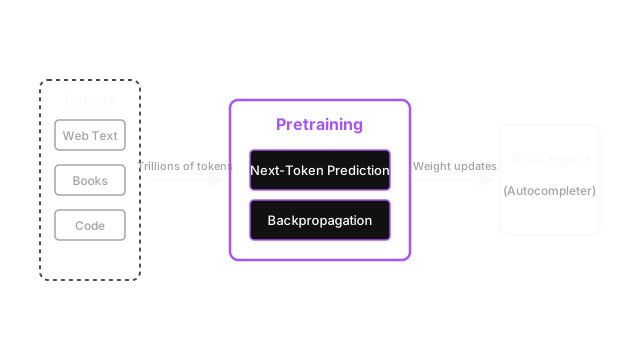
Pretraining is the massive, unsupervised ingestion of raw text that turns random noise into a statistical model of language, building the foundational world model that fine-tuning later shapes into a useful assistant.
Why Does This Exist?
If you want an AI assistant that can write Python, summarize legal contracts, and converse in French, you could try to train it from scratch on those specific tasks. But supervised data—where a human provides the question and the perfect answer—is rare and expensive.
Pretraining solves the data bottleneck by using the internet itself as the supervisor. By simply masking the next word in trillions of sentences and asking the model to guess it, pretraining forces the network to compress the entirety of human knowledge into its weights. It learns grammar, facts, reasoning, and coding syntax not because it was explicitly taught them, but because understanding them is the only mathematical way to accurately predict the next word across a diverse dataset. The result is a "base model"—a powerful autocompleter that knows everything but doesn't yet know how to be helpful.
Think of It Like This
Building a library before opening the reference desk
Imagine you want to hire a world-class reference librarian. You don't start by teaching a toddler how to politely answer a patron's question. First, you need them to learn to read, understand physics, history, and literature, and memorize the contents of every book in the building.
Pretraining is the decades of reading. It is the unstructured, massive acquisition of knowledge. Fine-tuning is the afternoon orientation session where you tell the well-read adult, "When someone asks a question, reply with a helpful summary, not by reciting the next paragraph of the book."
How It Actually Works
The Objective: Next-Token Prediction
The core mechanism of pretraining is deceptively simple: next-token prediction (or self-supervised learning). The model is fed a sequence of tokens (words or sub-words) and is asked to predict the very next token. Because the data is already text, the "correct answer" is naturally the actual next word in the document. The model makes a guess, computes the loss (how wrong it was), and backpropagates the error to update its billions of parameters. When repeated across trillions of tokens, the network begins to recognize patterns, then syntax, then facts, and eventually complex reasoning.
The Corpus: Trillions of Tokens
A model is only as good as its pretraining data. Datasets (often called a "corpus") are scraped from the web, digitized books, academic papers, and code repositories. However, raw internet data is filled with garbage. The bulk of modern pretraining engineering is actually data curation: filtering out boilerplate, removing toxic content, deduplicating repetitive text, and ensuring high-quality sources (like Wikipedia or GitHub) are weighted appropriately.
The Scale: Thousands of GPUs
Pretraining is the most computationally expensive phase of creating an LLM. It requires thousands of GPUs running continuously for weeks or months. This massive scale necessitates complex distributed training strategies like tensor parallelism (splitting a single layer across multiple GPUs) and pipeline parallelism (splitting the network's layers across different nodes). The sheer cost—often tens of millions of dollars—is why very few organizations train foundation models from scratch, and most rely on open-weight base models to fine-tune.
Watch Out For
Treating a base model like a chatbot
A raw pretrained model is an autocompleter, not an assistant. If you prompt a base model with "What is the capital of France?", it might not answer "Paris." It might autocomplete with "What is the capital of Germany?" because it thinks it's looking at a geography quiz from a web page. You must instruction-tune (fine-tune) a base model before it behaves conversationally.
Data contamination
If the benchmark tests used to evaluate the model (like coding puzzles or reasoning tests) accidentally slip into the massive pretraining corpus, the model will simply memorize the answers rather than learning how to solve them. This gives a false illusion of high performance, known as benchmark contamination.
The Quick Version
- Pretraining is the unsupervised phase where a model learns language, facts, and reasoning by predicting the next token across trillions of words.
- It is the most expensive and time-consuming part of building an LLM, requiring massive datasets and thousands of GPUs.
- The output is a "base model" (a powerful autocompleter) that must undergo further fine-tuning to become a helpful assistant.
- Data quality is paramount: filtering, deduplication, and mixing the right proportions of code, math, and prose determine the model's ultimate capabilities.