Test-Time Compute
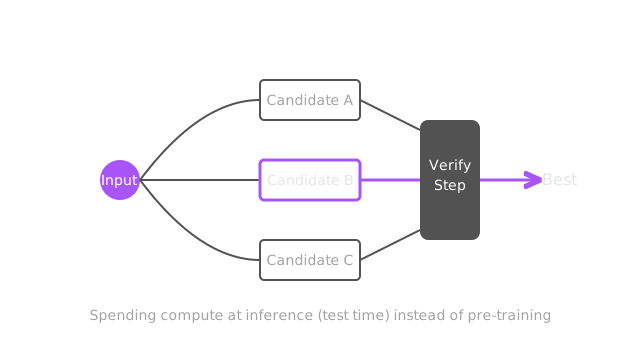
Instead of trying to make the model infinitely smarter during training (which is wildly expensive), spend your compute budget during inference (test time) to have the model generate multiple answers and verify the best one.
Why Does This Exist?
For years, the AI industry followed a single law: to get a smarter model, you must spend exponentially more compute during the pre-training phase. If a 10-billion parameter model isn't smart enough, train a 100-billion parameter model.
But training massive models costs hundreds of millions of dollars, and we are running out of high-quality human data to train them on.
Researchers realized there is another axis. Instead of spending all the compute upfront during training, what if we spend it at the very end, during inference (often called "test time")? By forcing the model to generate multiple candidate solutions, critique them, and search for the best path, we can massively increase the intelligence of the output without needing a larger foundational model.
Think of It Like This
The Chess Grandmaster vs The Novice
Pre-training compute is like giving a chess player years of study so they instantly recognize good moves by instinct.
Test-time compute is giving the player more time on the clock during the actual game. A slightly weaker player who is allowed to sit and think for 30 minutes, simulating 50 different future board states in their head, will consistently defeat a Grandmaster who is forced to move instantly in 1 second.
By trading time for search, you bridge the intelligence gap.
How It Actually Works
Test-time compute relies on wrapping the LLM in a search algorithm. The most common implementation is "Sample and Verify" (or Best-of-N).
1. Generation (Sampling)
When the user asks a complex question, the system does not generate a single answer. It asks the LLM to generate different answers (e.g., 64 independent attempts at solving a math problem). Because temperature introduces randomness, the model will take 64 slightly different logical paths. Some will be wrong, some will be right.
2. Verification (Scoring)
The system must now figure out which of the 64 answers is best. It passes each answer to a Verifier. The Verifier is often a specialized Process Reward Model (PRM) trained exclusively to spot logical flaws. The Verifier grades all 64 paths.
3. Selection
The system selects the candidate with the highest verification score and returns it to the user.
The Trade-off
You have drastically increased the quality of the answer, but you paid a massive price in compute. Generating 64 answers takes 64x more API credits and significantly more time. This is why test-time compute is reserved for coding, mathematics, and logic, rather than casual chat.
Code
This conceptually demonstrates a Best-of-N test-time compute wrapper.
def test_time_compute_wrapper(prompt: str, n_samples: int, generator_llm, verifier_model): candidates = [] # 1. Spend compute to generate N different paths for i in range(n_samples): # High temperature ensures diverse logical approaches answer = generator_llm.generate(prompt, temperature=0.7) candidates.append(answer) best_score = -1.0 best_answer = None # 2. Spend compute to verify and score each path for answer in candidates: # The verifier looks for logical consistency score = verifier_model.grade_logic(prompt, answer) if score > best_score: best_score = score best_answer = answer # 3. Return the single best result return best_answer
# Usage: We trade 10x the compute cost for a much higher chance of successfinal_solution = test_time_compute_wrapper("Solve this integral...", n_samples=10, ...)Watch Out For
The Verifier Bottleneck
Test-time compute ONLY works if your Verifier is smarter than your Generator. If the generator creates 64 answers, and 63 are wrong, the verifier must be flawless at spotting the mistakes. If the verifier is weak, it will accidentally select a hallucinated, highly-confident wrong answer. In modern systems, the verifier is often the most critical and closely-guarded part of the architecture.
The Quick Version
- The historical approach to AI was spending massive compute during pre-training to make the base model smarter.
- Test-time compute shifts the spending to the inference phase, wrapping the model in a search algorithm.
- The system generates dozens of candidate answers, exploring multiple logical paths in parallel.
- A specialized verifier grades the candidates and returns the most logically sound answer.
- This allows a smaller, cheaper model to achieve Grandmaster-level performance on hard problems by simply "thinking longer."