Visual explainer
Dimensionality Reduction
How PCA keeps 85 percent of spread on two axes, and when neighbour-keeping maps serve you better.
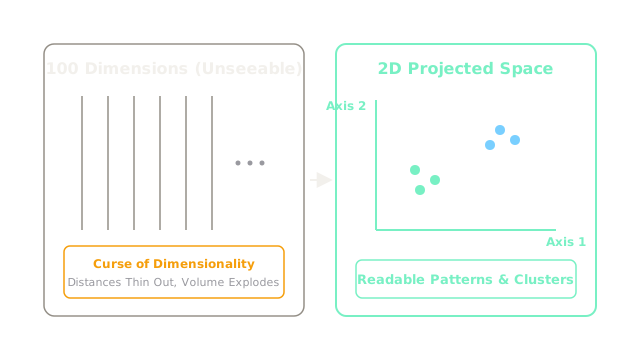
A hundred dimensions give you no picture and thinning distances. You cannot point at anything or reason about closeness. Squashing to two readable axes turns the cloud back into something your eyes can use.
Widest Spread Wins
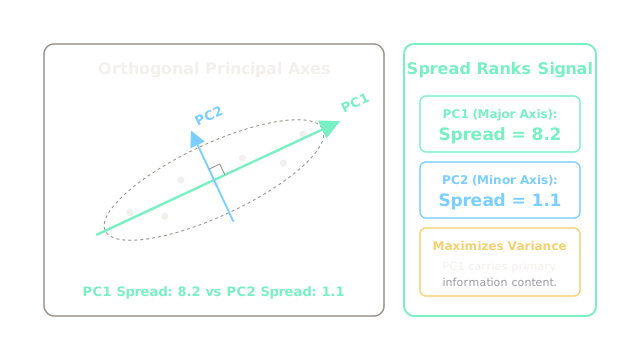
PCA ranks directions by spread. Your cloud stretches 8.2 along one axis but only 1.1 along the other, so the wide one carries the signal. Variance is spread squared, and widest keeps the most information.
Two Axes Keep 85
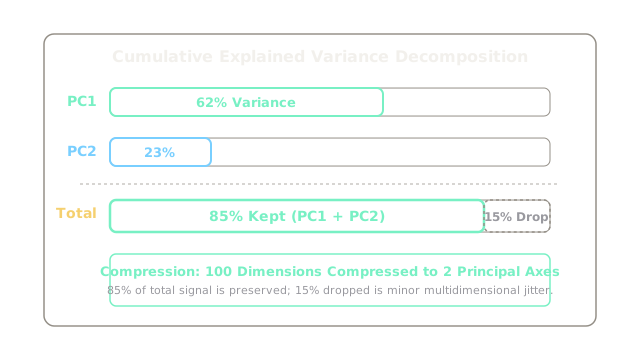
Project onto the top two axes and count what survives. PC1 holds 62 percent, PC2 adds 23 percent, so 85 percent stays while 15 percent of small jitter drops. Two numbers now stand in for a hundred.
Friends Stay Close
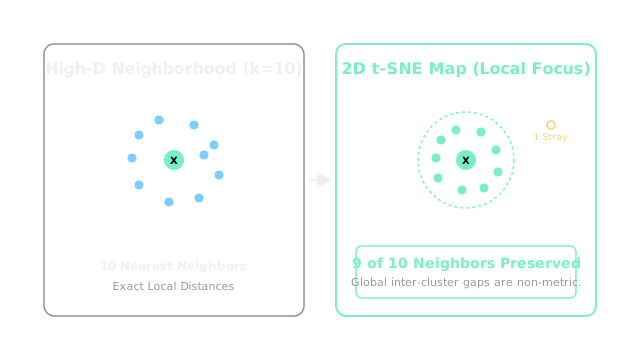
t-SNE plays a different game: keep each point near its friends. Nine of ten neighbours stay close, but distant crowds park wherever they fit. Read closeness on this map, never the gaps between crowds.
Point At Crowds
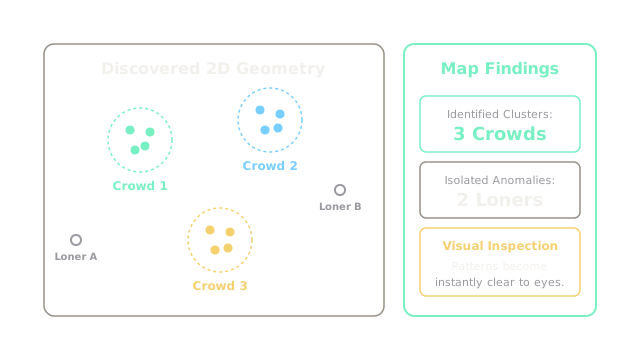
The payoff is a map you can point at: three crowds with distinct marks plus two loners sitting apart. The same points hid in the hundred-dimension cloud. Now outliers and groups announce themselves to you.
Models Or Eyes
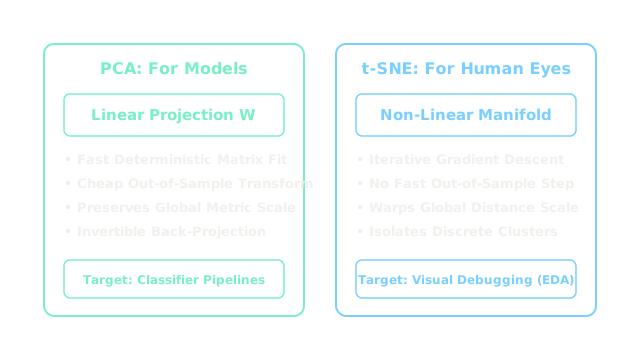
PCA costs one matrix and maps new points for free, so you feed it to models. t-SNE reruns per map and cannot place newcomers, so you draw with it for your eyes. The reader flips the tool: model or you.
Where It Breaks
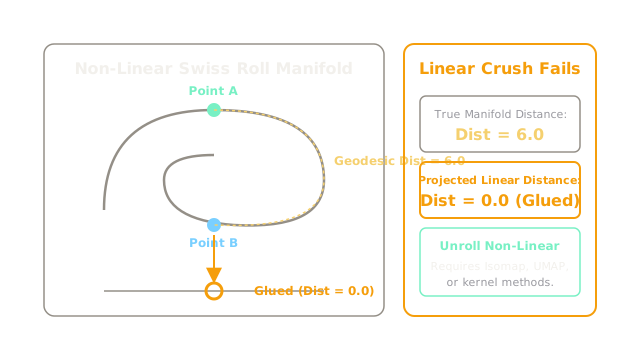
Roll your data like a carpet and flat PCA crushes layers together. Points A and B sit 6 apart along the roll yet land on one spot. Unroll curved shapes with a nonlinear method before you trust any map.
The Quick Version
- A hundred axes show nothing at once.
- Spread 8.2 beats spread 1.1 outright.
- Two axes keep 85; 15 drops.
- Nine of ten neighbours stay close.
- Finished map: three crowds, two loners.
- Models take PCA; eyes take t-SNE.
- Flat crush glues far points together.